
How to Find Your Next Hire in Your Own Breakroom
Picture this. Your marketing coordinator (you know, the one who taught herself SQL over the winter, built the dashboard your CMO now screenshots for board meetings, and quietly fixed your spreadsheet problem) just accepted a data analyst role. At another company.
Your data team had an open analyst req for four months. She never applied. Your recruiter never called her. And now you’re paying an agency fee to backfill a role she could have grown into and paying to replace her old role too.
Congratulations: you just sourced a great analyst for your competitor.
The Problem
Most companies treat internal mobility as a retention program. Something HR runs. A policy in the handbook nobody’s read since onboarding. A career portal designed 15 years ago.
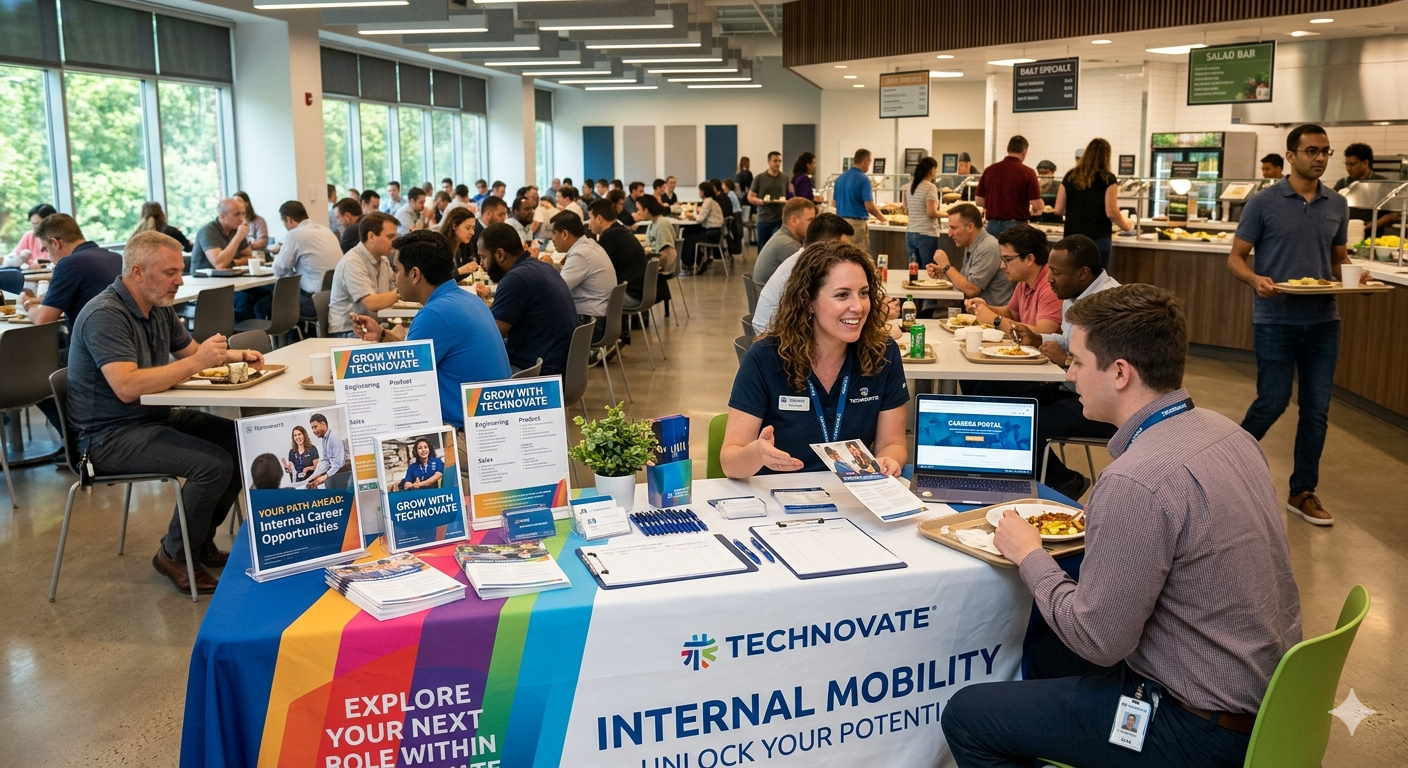
That framing is the mistake. Internal mobility isn’t a retention program. It’s a sourcing channel and almost assuredly your highest-converting one. The “candidates” are pre-vetted, culture-verified, and already badge-in every morning. They have performance data attached. Real performance data, not the “increased efficiency by 40%” variety on resumes.
And yet most talent teams will spend hours cold-messaging strangers on LinkedIn before spending ten minutes searching their own HRIS.
Why? Because sourcing is measured on external pipelines. Recruiters get credit for filling reqs with outside hires. Nobody gets a gold star for noticing that the answer was sitting in the breakroom microwaving leftovers.
The Data Is Embarrassing
LinkedIn’s workplace research has consistently shown that employees at companies with strong internal mobility stay significantly longer — roughly double the tenure compared to companies where moving up means moving out. Meanwhile, external hires typically cost more, ramp slower, and fail at higher rates in their first two years than internal movers.
So the highest-quality, lowest-cost, fastest-assimilating candidate pool is the one with zero recruiter attention.
If an external sourcing channel performed like internal mobility does, you’d build your whole strategy around it. You’d give it a budget line and possibly a mascot.
Early Talent Hires Are the First to Walk
This hits early talent hardest, and if you run university recruiting, this is your problem whether you’ve claimed it or not.
You spent eighteen months building a relationship with that grad. Career fairs, case competitions, an internship, an offer, onboarding. Then — silence. The implicit message: “We fought hard to get you here. Now stay in your lane.”
New grads don’t think in lanes. They think in trajectories. A 2023 software engineering hire who’s gotten curious about product management isn’t disloyal — she’s developing exactly the way you hoped she would. The only question is whether that development happens on your org chart or someone else’s.
Here’s the uncomfortable math: if your average campus hire leaves at year two, right when they’ve become genuinely productive, your university recruiting program isn’t a pipeline. It’s a very expensive training academy for the rest of your industry. You’re welcome, everyone.
Treat the Breakroom Like a Talent Pool
So what does “internal mobility as sourcing” actually look like in practice? Not a poster campaign. A workflow change.
1. Put internal search first in the req process — literally first. Instead of opening the req, posting externally, and letting the internal job board collect dust, try this: Ask: “Who already works here who could do this role in six months with support?” Make recruiters run an internal search before the external posting goes live, and make them document who they found. If the answer is genuinely nobody, then you source externally with a clear conscience.
2. Source on skills signals, not job titles. Your HRIS says “Customer Success Associate.” It doesn’t say “built three internal automation tools and runs the unofficial policy governance for the whole department.” Skills inventories, project data, even certification feeds — that’s your internal sourcing database. If you adopted skills-based hiring for external candidates and didn’t point it inward, you only did half the project. Note: For more on skills-based hiring, read my recent article on the subject.
3. Give recruiters credit for internal fills. What gets measured gets sourced. If an internal placement counts as zero on the dashboard, recruiters will rationally ignore the breakroom forever. Count internal fills. Celebrate them. Track quality-of-hire for internal movers against external hires and watch what the comparison tells you. (Spoiler Alert: it will tell you to do more internal hiring.)
4. Kill the permission tax. In too many orgs, applying internally requires telling your manager first, which is a bit like requiring people to announce a breakup before they’re allowed to flirt. Managers hoard talent because losing a strong performer hurts their team’s numbers. Fix this. Make “exported talent to other teams” a leadership metric, not a leadership wound.
5. Build mobility into the early talent promise — and keep it. Your campus pitch already says “endless opportunities to grow.” Make it operational. Create an 18-month check-in where the conversation is explicitly about internal options. Internal “open houses” where teams pitch themselves to employees the way you pitch to students at career fairs. You already know how to sell roles to 22-year-olds. Sell them to your 24-year-olds too.
The Objection
“But if we move people internally, we still have to backfill the old role.” True. But you backfill a junior role with a warm employer brand story (“people grow here”) instead of replacing a flight-risk mid-level performer at market-rate panic pricing. One of those problems is much cheaper than the other. Also, candidates can smell the difference between a company that promotes from within and one that says it does. So can Glassdoor.
The Bottom Line
Every quarter, somewhere in your company, an employee quietly decides whether their next chapter happens with you or without you. Your sourcing strategy either shows up to that decision or it doesn’t.
You don’t need a new tool. You don’t need a transformation initiative with a steering committee. You need recruiters who check the breakroom before they check LinkedIn.
Where does internal mobility sit in your org right now — sourcing channel, retention program, or handbook decoration? I’d genuinely love to hear what’s worked (or spectacularly hasn’t) in the comments.
If you’re rethinking how your early talent strategy connects to internal mobility — from skills-based internal sourcing to building mobility into your campus value proposition — that’s exactly the work we do at ES Talent Solutions. Let’s talk. I’m always happy to talk with fellow leaders about building recruiting functions for the future. Let’s build something better.



0 Comments
The Regulatory Roadmap, Part 2
January 1 brings new AI hiring rules in Colorado and California, and they all start with one question: which tools in your funnel score, rank, or filter candidates? Most compliance problems in 2027 will start as inventory problems in 2026.
The Regulatory Roadmap, Part 1: Auditing your Automated Sourcing & Screening Tools
January 1 brings new AI hiring rules in Colorado and California, and they all start with one question: which tools in your funnel score, rank, or filter candidates? Most compliance problems in 2027 will start as inventory problems in 2026.
Ageism in the AI Era: Is Your Process Screening Out Your Most Loyal Hires?
Your AI screener doesn’t need to know a candidate’s age. A graduation year and a 25-year work history give it away. Workers over 50 stay roughly three times longer, and the Workday lawsuit shows what screening them out can cost.