
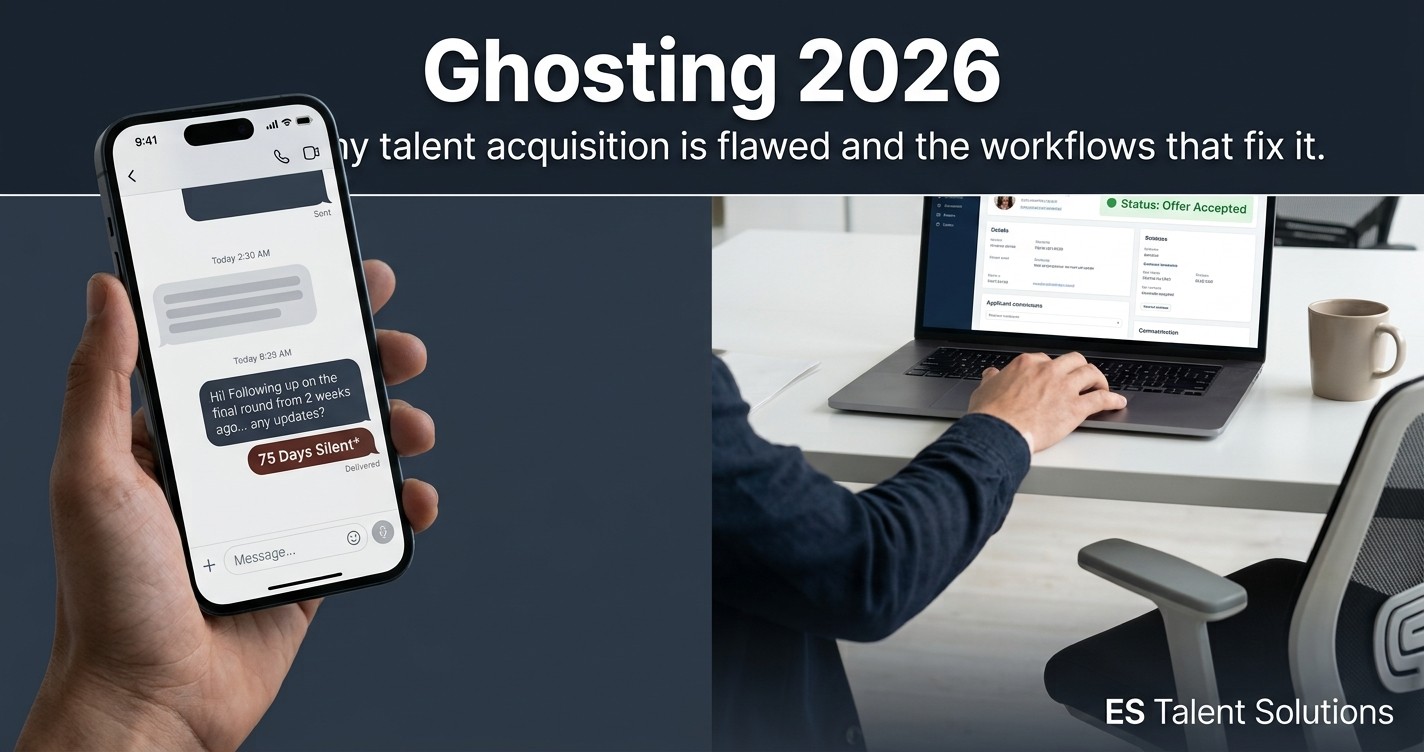
I interact with several “In-Transition” groups through local associations and am happy to give insight into job search. If you’ve ever been around those in job search mode, it doesn’t take long to get to the subject of ghosting. It’s a BIG problem. So big, in fact, that I would estimate the percentage of people applying for jobs who have been ghosted at least once is close to 100%. A post by Gerry Crispin at CareerXroads.com had me thinking it’s time to write about it.
A corporate recruiter can head to their Applicant Tracking System (ATS) and find lots of candidates who have made it to the final round of interviews and are still sitting in “under review”. There are a lot more candidates who will never be considered in the same status. That’s the way these things go when everyone’s busy, right?
The Problem
For years, the ghosting conversation has been framed as one-directional: employers disappearing on candidates. That story is convenient and it’s incomplete. Ghosting in 2026 is a two-way street with heavier traffic in both directions than most hiring leaders want to admit.
AI tools have made applying effortless, so candidates apply to more roles than they can meaningfully track, and a polished, tailored-looking application no longer signals real intent, it just signals access to nifty tools. That flood overwhelms recruiting teams, who respond to fewer people because there are more people to respond to. Candidates notice the silence, decide it’s the norm, and start returning the favor further down the funnel. Recruiters notice candidates vanishing and get more guarded about investing time in any one person. Everyone is protecting themselves from a system nobody really built but everybody is now participating in.
Would you keep answering calls from someone who let half of yours go straight to voicemail? Most candidates wouldn’t either, and increasingly, they don’t.
The Data Behind the Standoff
Start with the employer side, because it’s worse than most TA leaders assume. 53% of job seekers say they were ghosted by an employer in the past year, a three-year high (This is survey data from Glozo.com – I’m sticking to my 100% number). 61% report being ghosted specifically after an interview, up nine points since early 2024. And this isn’t a few bad actors: 80% of hiring managers admit to ghosting at least one candidate, with 81% of those citing the same reason, they were “still deciding if the candidate was the best option” and just never closed the loop once they’d moved on.
Now the candidate side. 41% of organizations report candidates ghosting them mid-interview process, and interview no-shows have become common enough that most TA teams now plan around them rather than treat them as exceptions. Here’s the part that should reframe how you think about it: 70% of job seekers describe employer ghosting as “fair.” Not ideal, not okay, fair. That’s reciprocity talking. If silence is an acceptable move for one side, most people will eventually decide it’s acceptable for the other.
Pin’s Employer Ghosting Index, built from over 200,000 recruiter-candidate conversations between January 2024 and May 2026, puts a sharper point on it: 72% of candidates in active conversation on roles that are still open go 30-plus days without a single follow-up from the recruiter. Median time since last contact: 75 days. That’s not a candidate falling off. That’s an employer who never came back.
Where It’s Actually Breaking
The funnel data shows this isn’t happening at one predictable moment, it’s leaking everywhere. Greenhouse’s research across 1,200 hiring processes found candidates going quiet at every stage: 24% after the initial recruiter call, 23% after the hiring manager interview, and another 24% combined after a skills assignment or final round, once they’ve already cleared the hardest parts.
Compare that to what candidates say they expect. Seventy-five percent expect a response within two weeks of applying. Fifty-eight percent expect one within a week. The actual median response time clocks in around 6.7 days, which sounds almost fine until you remember that’s a median, not a floor, and over a third of applicants report hearing absolutely nothing for one to two months. Every candidate sitting past that expectation window is a candidate quietly deciding your process, and by extension your company, isn’t worth their continued attention. That’s not disloyalty. That’s a reasonable person adjusting their strategy on the evidence in front of them.
What Not to Do
The instinct a lot of TA leaders reach for is a lecture, tighter language in the offer letter about professional courtesy, a “ghosting policy” candidates have to acknowledge before applying, maybe a quiet blacklist so a candidate who disappears once never gets a second look. That’s ridiculous. None of that touches the actual issue. You can’t shame your way out of a system problem.
The other common instinct is automation without follow-through: a “your application is under review” auto-reply that executes once and never updates again, so the candidate technically got a response and is still, functionally, ghosted. Worse than silence, sometimes, because it manufactures the appearance of a process that isn’t happening behind it.
Would you accept “we sent a receipt” as proof that a customer complaint got resolved? Candidates don’t accept it either, and the data above suggests they’re increasingly willing to return exactly that energy right back at you.
The Cure
A few moves that address the mechanism instead of the symptom.
First, publish a disposition Service Level Agreement (SLA) and align staff appropriately to hit it. Top-rated employers disposition candidates within three to five days at every stage, and that speed correlates with 52% fewer long-wait complaints and a candidate Net Promoter Score (NPS) of 59 versus a 40-point average for everyone else. The SLA only works if someone owns checking it weekly, not just announcing it once in a kickoff meeting. And recruiting leaders, please go one step further. @GerryCrispin and the CXR Foundation Standards Committee (of which I am a member) has created a Baseline Standard for Applicant Closure establishing minimum standards for when applicants are no longer under consideration for a role. Read the standard and declare your support.
Second, filter for intent earlier so you’re not drowning in applications you can’t respond to. Knockout questions, a short screening call, or a role-specific prompt in the application filters out the volume that AI auto-apply tools generate without meaningfully slowing down candidates who actually want the job. There are some nifty AI tools out there that can help with this as well. Fewer, better-qualified applicants in the pipeline means you can actually answer the ones who are left.
Third, build an automated silence trigger into your ATS or CRM. If a candidate in active conversation hits day five, ten, and fifteen without a human touchpoint, that should fire an alert to the recruiter, not wait for the candidate to give up first. Given that 72% of active candidates currently go 30-plus days without follow-up, even a basic 10-day check-in cadence would put you ahead of most of the market.
Fourth, keep your runner-up candidates warm instead of rejecting them the moment you extend an offer. A third of employers formally reject their alternates before the primary candidate has even confirmed, which means when that candidate ghosts you post-acceptance, you’ve got nobody left in the pipe and have to start cold. A short, honest “we’ve made an offer to another candidate, we’d like to keep you warm for 30 days” email costs nothing and saves you a full re-source when things fall through. Honesty and full disclosure carry a lot of weight in the current environment.
Fifth, don’t let the loop close at “yes.” Nearly nine in ten employers cite day-one no-shows as an active problem, which tells you ghosting doesn’t stop at offer acceptance, it just moves later. A light-touch weekly check-in between acceptance and start date, a welcome call, an intro to the team, a logistics email, keeps the relationship alive through the exact window where new information (a counteroffer, a competing final round, cold feet) is most likely to change someone’s mind quietly. Make sure the hiring manager is involved – nothing develops a bond more than the HM calling to check in.
Candidate ghosting isn’t a generational character flaw and it isn’t going to get fixed by a stricter tone in your rejection template. It’s a trust economy, and right now both sides are pulling out of it at close to the same rate, for close to the same reason: nobody’s confident the other side will follow through, so nobody commits fully to following through themselves.
You can’t out-lecture that. You can out-process it, with SLAs someone actually owns, automation that catches silence before it hits 75 days, and a pipeline that doesn’t burn its second-choice candidates the moment it makes a first choice. Don’t forget to also take a public stand (Baseline Standard for Applicant Closure) to help put an end to this practice. I’m a life-long recruiter and could think of nothing better than erasing this stain on our profession before I retire.
Ghosting used to be an accepted practice with few consequences. That’s changing. A newly created website, DidTheyGhostYou.com , is capturing candidate ghosting activity along with a Ghosting Leaderboard – not exactly the kind of contest your company wants to win.
What’s your organization’s actual disposition SLA, not the one in the handbook, the one candidates are really experiencing? Has anyone checked lately whether you’re hitting it? Do you think this is even a problem? Drop a comment, I’d genuinely like to compare notes.
If your team is losing candidates to silence and you’re ready to build the workflows that fix it instead of another policy nobody reads, that’s exactly the kind of work ES Talent Solutions does. Reach out to me (estewart@ESTalentSolutions.com) and let’s talk.
#CandidateExperience #Ghosting #TalentAcquisition #Recruiting #HRLeadership #ESTalentSolutions



0 Comments
Ageism in the AI Era: Is Your Process Screening Out Your Most Loyal Hires?
Your AI screener doesn’t need to know a candidate’s age. A graduation year and a 25-year work history give it away. Workers over 50 stay roughly three times longer, and the Workday lawsuit shows what screening them out can cost.
Quiet Commitment: Why DEIB Is Moving From Public Statements to the Invisible
“DEI” mentions in S&P 500 filings fell 68% in a year. But most companies didn’t cut the work. They moved it into the hiring process, and the fairest practices turn out to be the most predictive too.
Remote Work Isolation: Not a Culture Problem but a Recruiting One
Remote work isolation isn’t a real estate problem. Lonely workers are nearly twice as likely to job hunt, and office workers are just as lonely. The fix starts in your interview loop, not your office lease.