
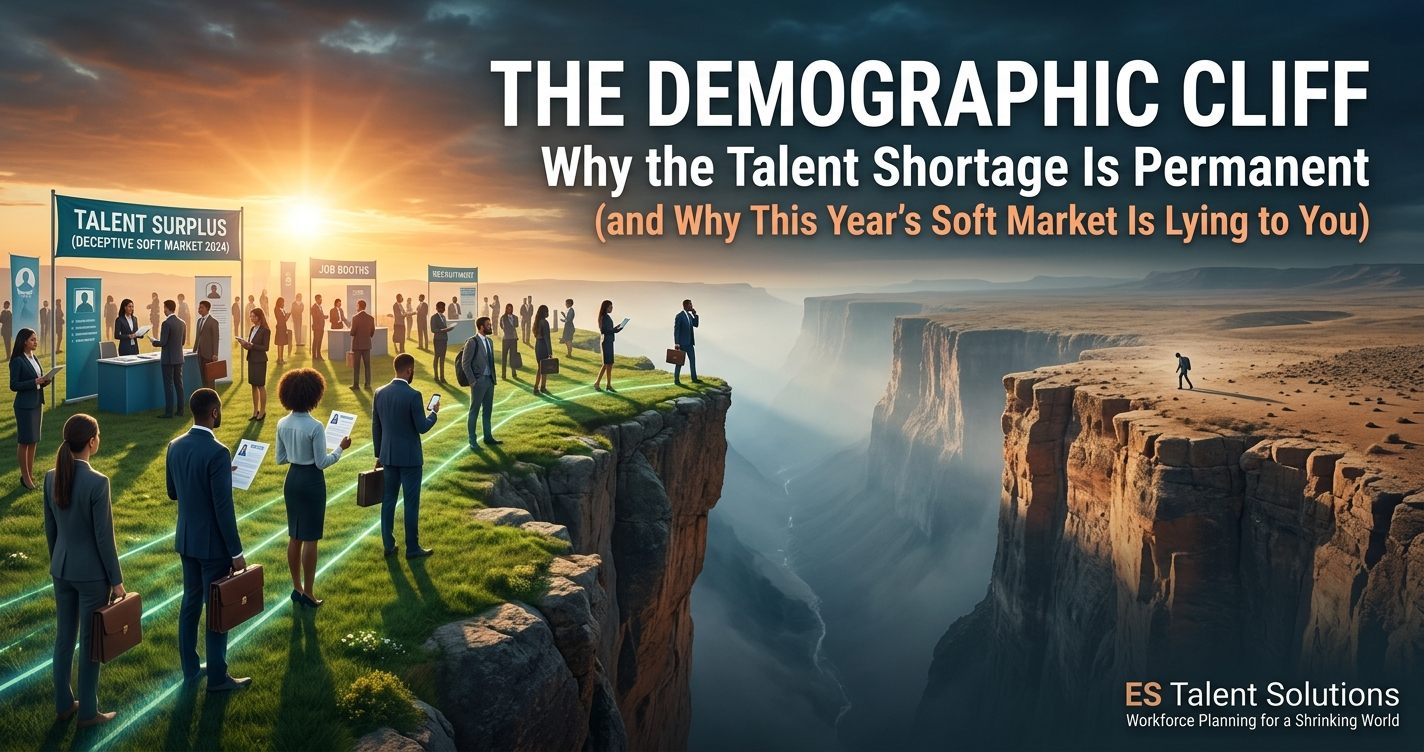
Why the Talent Shortage Is Permanent (and Why This Year’s Soft Market is Lying to You)
I was at some level of recruiting role during the dot-com bust, the 2008 crash, a pandemic, and the Great Resignation. Every one of them taught me the same lesson: be patient. Tight markets loosen. Candidates come back. Hold the line on the req long enough and the market eventually hands you the person you were looking for.
That lesson is about to make a lot of recruiting leaders look very wrong.
Most of us still think about talent supply as a cycle. Unemployment goes up, candidates get easy. Unemployment goes down, candidates get hard. That model worked for forty years because underneath every cycle sat a population that kept growing. Each year, more people walked into the workforce than walked out.
That’s ending this decade. Not slowing. Ending.
Even the Federal Reserve has noticed. Earlier this year, then-Fed Chair Jerome Powell described labor force growth as “very, very low, nonexistent, really.” When the Fed chair sounds like a frustrated recruiter, pay attention.
The Math
The reason this is different than other forecasts is that this is not a forecast. Most of it has already happened.
Start with births. The Centers for Disease Control and Prevention (CDC) provisional data shows roughly 3.6 million babies born in the U.S. in 2025, a record-low fertility rate and nearly 23% below where it stood in 2007. Those missing births don’t show up as a hiring problem for twenty years, and then they show up every year after that.
Now follow the kids we did have. The Western Interstate Commission for Higher Education’s (WICHE) Knocking at the College Door projects that U.S. high school graduates peaked in 2025 at about 3.9 million, the largest class ever recorded, and will decline roughly 13% by 2041, with 38 states seeing losses. The entry-level workforce of 2040 isn’t a projection. It’s sitting in elementary school right now.
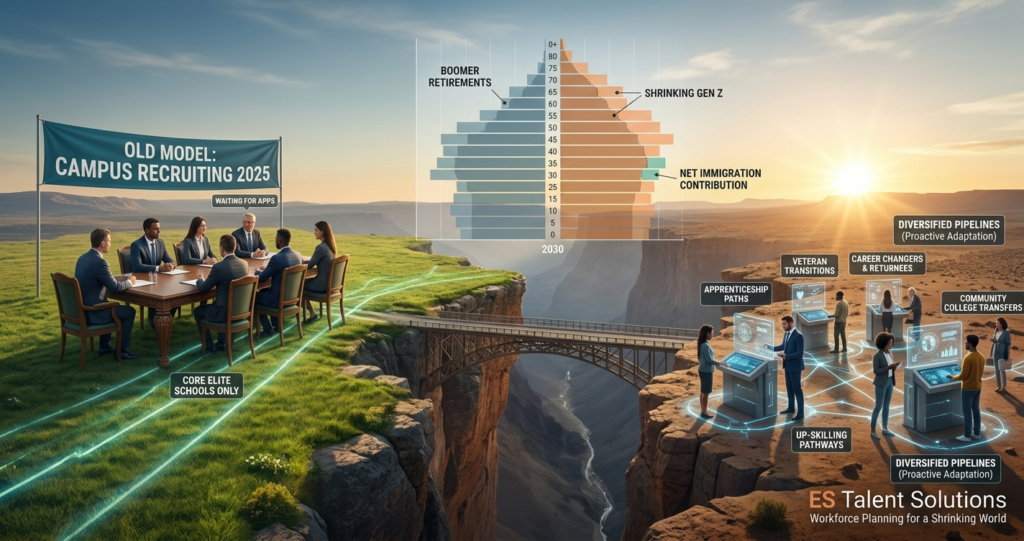
Then the big one. The Congressional Budget Office (CBO) projects that starting in 2030, annual deaths will exceed annual births in the U.S. From that point on, net immigration accounts for all population growth, and the overall growth rate drops to about 0.1% a year from 2037 onward.
Put it together and you get what Indeed Hiring Lab projected this spring: the U.S. labor force will shrink by roughly 3.7% (just under 6 million workers) between 2025 and 2032. Their economists call it a demographic cliff, driven by Baby Boomers retiring faster than younger generations can replace them.
You can’t recruit people who were never born. Most forecasts are guesses. This one comes with birth certificates.
The Paradox
Many (most?) of you think I’m totally off base. More people are applying for jobs, getting hundreds of applications consistently. And I agree entry-level white-collar hiring is brutal for job seekers right now. And that’s exactly the trap. If your inbox is overflowing, it’s easy to conclude the shortage was a pandemic-era blip and the pendulum has swung back.
But looking closer, Indeed’s research finds the deepest projected shortages in construction and healthcare, which they note are precisely the fields where AI offers the least relief. Meanwhile, new grads keep clustering in finance, information, and business services. So you get a loose market and a permanent shortage at the same time, depending on which req you’re staring at.
And a pile of applications isn’t the same thing as a pool of talent. With AI auto-apply tools, 600 applicants can mean 600 clicks and 12 people who actually want the job. (I covered that dynamic in my recent article Candidate Ghosting: Why Is This Still Happening?)
A flood of applicants isn’t a surplus of talent. It’s a surplus of applications.
Where the Work Actually Is
If the shortage is structural, waiting is no longer a viable strategy. Here’s where to start:
- Waiting for the market to loosen won’t work. Diagnose the demographics around your critical roles. Which ones are short on talent (remember, not applications but talent) and will it stay that way every year from here on?
- Instead of building every plan around external hiring, explore a build-versus-buy strategy. (Yep, I wrote about that also in Internal Mobility As A Sourcing Tool)
- Examine the retirement situation. Who is eligible to retire in the next five years and what do they know that nobody else does? Phased retirement and bridge roles are recruiting tools now.
- Don’t hold out for the 100% match. It might not be worth shrinking a pool that’s already shrinking on its own.
- Expand the metrics you track to include first-year retention. In a shrinking market, every regrettable loss is a hire you may not be able to make again.
- Stop sourcing from the same pools. Figure out how to assess for great hires from career changers, returners, experienced workers, people without degrees. You’re saying, “This won’t work for my jobs”. Yes, it will. Figure it out.
Campus Recruiting Will Feel It First
For those hiring on campus, this isn’t a 2040 problem. The record high school class of last year is graduating college in 2029. After that, every graduating class gets smaller, and colleges have been bracing for this “enrollment cliff” for a decade. If your campus strategy assumes the same six core schools will deliver the same volume in 2032, you’re planning against a pipeline that has already started to shrink.
The campus teams that win from here will widen their school lists, treat intern conversion as a headline metric instead of a footnote, and start relationships earlier: sophomores, community colleges, apprenticeship programs.
The Usual Objections
“AI will solve this problem”. In some places, partly. But the shortage and the automation are landing in different parts of the economy. AI is reshaping white-collar work, where the applicant pile is already high. It’s doing far less in nursing, skilled trades, and field service, where the people are disappearing fastest. Go ask a hospital’s chief nursing officer whether a chatbot can cover a night shift.
The other objection I hear is “immigration will fill the gap.” That’s a policy debate, and I’ll leave it to people with better credentials on the topic. As a recruiter, I’ll say this: CBO already counts on immigration for all U.S. population growth after 2030, and its immigration estimates swing substantially from year to year. A workforce plan that only works if a policy variable breaks your way isn’t a plan. It’s a hope.
For forty years, tight labor markets were weather. You waited them out. The demographic cliff is climate. You don’t wait out climate. You adapt to it.
So here’s a question worth putting to your leadership team: if talent never got easier to find than it is today, what would you change about your recruiting strategy? Drop a comment. I’d genuinely like to hear how teams are planning for it.
If you want help building a workforce plan that holds up in a shrinking market, from build-versus-buy decisions to retention to a campus pipeline that’s ready for smaller classes, that’s exactly the kind of work ES Talent Solutions does. Reach me directly at estewart@ESTalentSolutions.com and let’s talk.

#DemographicCliff #TalentShortage #WorkforcePlanning #TalentAcquisition #EarlyTalent #HRLeadership #ESTalentSolutions


0 Comments
The Regulatory Roadmap, Part 2
January 1 brings new AI hiring rules in Colorado and California, and they all start with one question: which tools in your funnel score, rank, or filter candidates? Most compliance problems in 2027 will start as inventory problems in 2026.
The Regulatory Roadmap, Part 1: Auditing your Automated Sourcing & Screening Tools
January 1 brings new AI hiring rules in Colorado and California, and they all start with one question: which tools in your funnel score, rank, or filter candidates? Most compliance problems in 2027 will start as inventory problems in 2026.
Ageism in the AI Era: Is Your Process Screening Out Your Most Loyal Hires?
Your AI screener doesn’t need to know a candidate’s age. A graduation year and a 25-year work history give it away. Workers over 50 stay roughly three times longer, and the Workday lawsuit shows what screening them out can cost.