
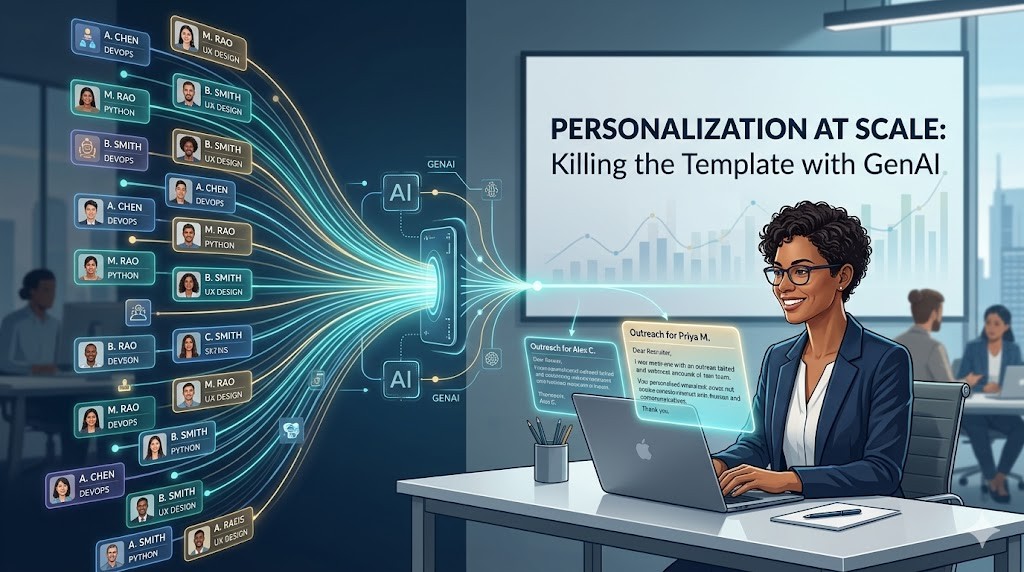
How to Use GenAI to Write Outreach That Doesn’t Feel Like a Template
There’s a recruiter somewhere right now sending this message:
“Hi [First Name], I came across your profile and was impressed by your background. I think you’d be a great fit for an exciting opportunity at a leading company in the [Industry] space…”
And the candidate is either deleting it or laughing. Probably both.
Why? The same AI revolution that gave recruiters powerful new outreach tools also made candidates significantly better at spotting templated garbage. The problem in recruiter outreach didn’t get better with GenAI. For most teams, it got worse.
But it doesn’t have to. Used correctly, GenAI doesn’t replace personalization, it scales it (For insight read a recent article, “The Future of Recruitment“). The distinction matters enormously, and most recruiting teams are completely missing it.
The Problem Isn’t AI. It’s How We’re Prompting It.
When I talk to recruiting leaders about AI-generated outreach, I hear a version of the same complaint: “We tried it, the messages felt generic, candidates weren’t responding.” And when I ask to see their prompts, the issue becomes immediately obvious.
They’re asking AI to write a message. They should be asking AI to research a person and then write a message.
Those are two completely different tasks. The first produces a template dressed up with a name swap. The second can produce something that actually reads like a human being spent time thinking about this specific candidate.
The shift is in the inputs you give the model, not the output you’re asking for.
What Real Personalization Actually Requires
Before GenAI can write a genuinely personalized message, it needs real signals about the candidate. Not just their job title and company. Actual intelligence.
Here’s what that looks like:
🔹 Career trajectory, not just current role. Is this person ascending in their career? Making lateral moves? Returning to a functional area they left? The pattern tells you something about what they’re optimizing for.
🔹 Tenure context. Someone who’s been in the same role for four years at a company that typically promotes in two is in a different headspace than someone who just changed jobs eight months ago. Context shapes receptivity.
🔹 Content they’ve published or engaged with. A post they wrote, an article they shared, a comment they left on an industry topic — this is a window into what they actually care about professionally.
🔹 Company context. Is their current employer going through layoffs? A recent acquisition? Leadership changes? A candidate whose company just announced a restructuring hears your outreach very differently than one who just received a promotion.
🔹 The specific intersection between their background and your role. Not “you have supply chain experience and this is a supply chain role.” The specific, non-obvious connection. “You built the vendor diversification program at [Company] — that’s exactly the challenge we’re trying to solve here.”
When you feed this kind of intelligence into a GenAI prompt, you stop asking it to write a message and start asking it to make an argument. Candidates respond to arguments. They delete templates.
Prompt Architecture That Actually Works
Most recruiters give GenAI about 30 words of context and expect a compelling, personalized message in return. That’s not how this works.
Here’s the framework I recommend:
1. Lead with the candidate brief, not the job description. Before you describe the role, describe the person. What do you know about them? What have you observed about their career choices? What signal have you picked up from their public presence? Make the AI work from a candidate perspective first.
2. Specify the “so what” explicitly. Tell the AI what the connection is between the candidate’s specific background and this specific role. Don’t make it figure this out. You’re the recruiter — you know why this person in particular caught your attention. Make that explicit in the prompt.
3. Define the tone and the ask. Short and direct, or more context-heavy? Are you asking for a reply, a 15-minute call, or just an open door? Be explicit. GenAI will default to something generic if you don’t define it.
4. Tell it what to avoid. Explicitly instruct the model not to use phrases like “exciting opportunity,” “impressive background,” “reach out,” or anything that reads like it was generated. You’d be surprised how much this helps.
5. Give it your voice. Paste in examples of messages you’ve written that landed well. Ask it to match that tone. The model will calibrate.
The Stack That Makes This Scalable
This level of research on every candidate sounds time-intensive. And it is if you’re doing it manually. The real power of GenAI in recruiter outreach isn’t in writing the message. It’s in compressing the research phase.
Here’s a workflow that works:
- LinkedIn + a research prompt. Pull key profile data and ask GenAI to synthesize career narrative, identify tenure patterns, and flag anything notable about trajectory. Two minutes instead of fifteen.
- Company news prompt. Ask GenAI to summarize any notable recent news about the candidate’s current employer — funding rounds, layoffs, leadership changes, acquisitions. Context that changes what your message says.
- Content scan. If the candidate has published content, a quick prompt asking for themes and interests gives you genuine conversational signal.
- Outreach synthesis. Now write the message with all of that context loaded in. You’re not asking GenAI to guess. You’re asking it to connect dots you’ve already gathered.
The research step takes five to eight minutes per candidate. The message takes another two. But the output reads like you spent an hour, because the thinking behind it is real. If this seems like too much of a time investment, think about all the other recruiters who think the same thing and don’t do it. Is it good to be fast with no replies?
The Authenticity Test
Here’s the test I give every AI-assisted outreach message before it goes out: Could this message have been sent to 100 people, or does it only make sense for this one person?
If it could have gone to 100 people, it’s still a template. It doesn’t matter that AI helped write it.
If a candidate reads it and thinks “they actually looked at my profile,” it’s working.
That’s the standard. Not whether AI was involved — candidates don’t care about that. They care whether a human being thought about them specifically before reaching out.
What This Doesn’t Replace
Personalized AI-assisted outreach is a first impression, not a relationship. The candidates you reach this way still need a real conversation with a real person who actually understands the role, the team, and what makes this opportunity worth considering.
The risk with GenAI outreach done well is that it raises the expectation for the conversations that follow. If your message is thoughtful and specific, candidates will expect the recruiter they speak with to be just as prepared.
That’s not a problem. That’s the point. GenAI handling the research and the drafting frees recruiters to have more of those high-quality conversations and fewer of the “let me pull up your profile real quick” ones.
The tools aren’t the strategy. They’re the enabler. The strategy is treating every candidate like their time and attention matter.
Most of your competitors aren’t doing that. Which is exactly why it works when you do.
What’s working in your outreach right now? Are you using GenAI to assist with personalization, or does it still feel like it’s producing templates? Drop your experience in the comments — I’d genuinely like to know where teams are on this.
ES Talent Solutions helps organizations build recruiting strategies that work in a world where candidates have options and short attention spans. Want to discuss how to build a modern outreach approach for your team? Contact Eddie Stewart at estewart@ESTalentSolutions.com. I’m always glad to talk with recruiting leaders who are serious about doing this right.



0 Comments
The High-Touch Rebound
The advancement of AI in recruiting has created a craving for human contact by candidates. This article defines the problem and provides information on what high touch recruiting should look like
The Un-Automated Recruiter
AI is infiltrating the recruiting space but that doesn't mean humans are going away. Their jobs are changing and this article discusses skills that will be valuable in this new role.
Interview Intelligence: AI Watching, Scoring, and Judging Your Candidates
Making the case for AI in the interview process and understanding where and why to use in are important in creating recruiting departments of the future