
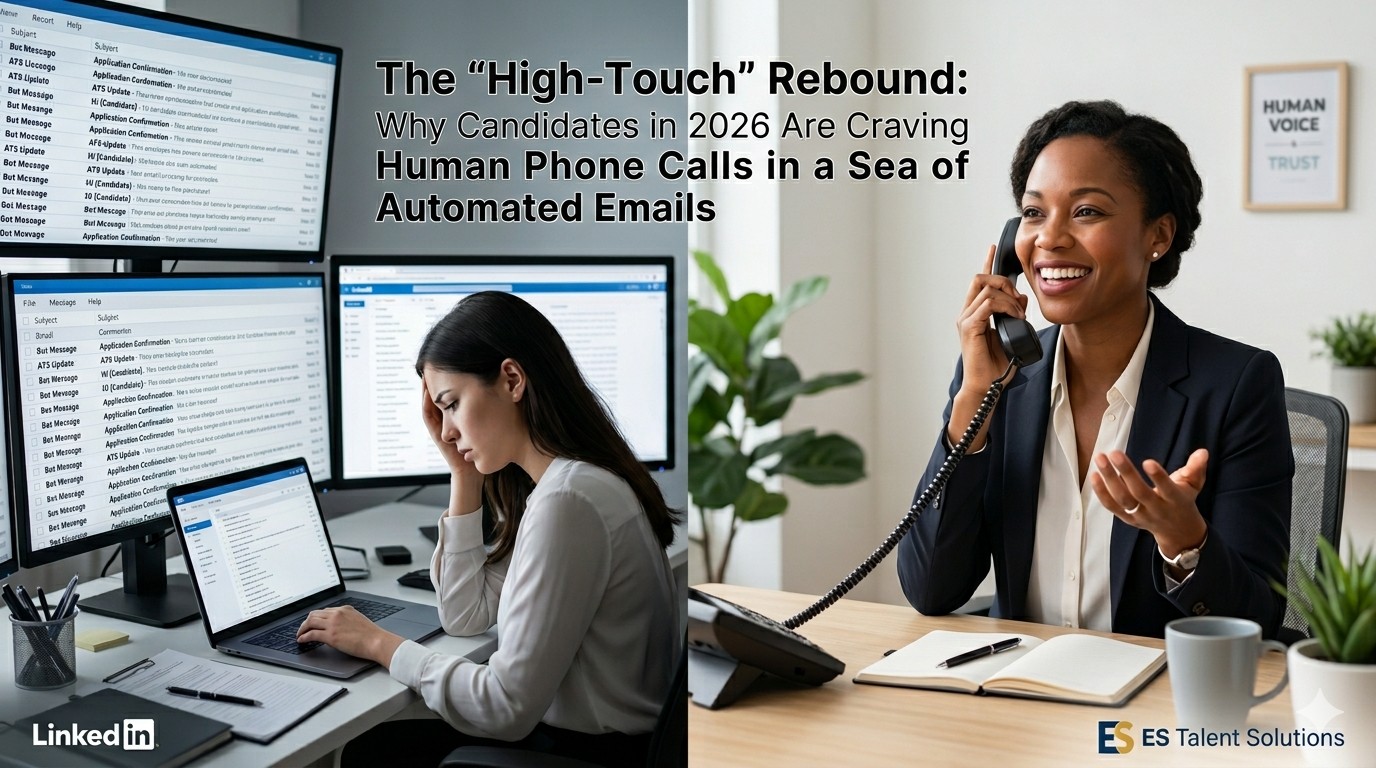
Why Candidates in 2026 Are Craving Human Phone Calls in a Sea of Automated Emails
Here’s a scenario that should sound familiar:
A candidate applies to six positions in a week. Within hours, their inbox fills up with automated confirmation emails and applicant tracking system (ATS) status updates. Then comes the invitation to complete an asynchronous video interview (pre-recorded one-way interview where candidates record their answers). Now comes the chatbot asking if there are any questions. And then… silence. Weeks of it.
No one called. No one asked what they’re actually wanting in their next role. Those six roles are completely forgotten about when an actual recruiter, who actually picks up the phone, calls. Do you think this generates more interest than the wave of auto bot chatter?
If you have applied for a job recently, you have experienced this. And this isn’t surprising to corporate recruiters trying to save time by send bulk automated messages. We are living through one of the most ironic moments in recruiting history: the more automated our outreach becomes, the more desperate candidates are for a real human voice.
Numbers Don’t Lie
The data coming out of 2025 and into 2026 is telling a very clear story and recruiters who ignore it are going to keep losing great talent to competitors who haven’t.
According to the 2025 Annual Job Search Trends Report, 83% of candidates reject AI-driven interviews, preferring to speak with a human being over recording responses for algorithmic analysis. That’s right, nearly nine out of ten job seekers, in the most tech-saturated hiring market we’ve ever seen, would rather wait for a real conversation than move fast through a bot-powered process.
And it’s not just interview format where candidates are drawing the line. A Lever survey found that 80% of job seekers say they would not reapply to a company that didn’t notify them of their application status and 65% say they rarely or never receive that basic courtesy. Meanwhile, research shows that candidates are four times more likely to consider your company in the future if you offer constructive, human feedback.
The trust gap is real, and it’s widening. A 2026 report by High5Test.com found that 46% of U.S. job seekers say their trust in hiring has declined over the past year, with 42% attributing that decline specifically to AI. When candidates feel processed instead of valued, they disengage. And, while most recruiters don’t have time to realize it, candidates ghost back. And your best opportunities walk out the door before you ever knew they were there.
We Created This Problem Ourselves
It’s no surprise that the recruiting industry did this to itself.
The pitch for automation was always compelling. AI adoption in HR climbed from 26% in 2024 to 43% in 2025 (SHRM Talent Trends, 2025). Automated emails, ATS workflows, chatbots, and asynchronous video screens promised to solve the volume problem. And to be fair, in some ways they did. Companies using AI-powered screening tools reduced time-to-screen by meaningful margins and cut cost-per-hire.
But somewhere in the race to process more candidates faster, we forgot that candidates aren’t applications. They’re actually people making one of the most important decisions of their professional lives.
Consider what’s happening on the ghosting front alone. Nearly 90% of job seekers report being left without closure after interviews (I feel that number might be low). This implies a purely transactional recruiting mindset – if the candidate no longer serves my purpose, I move on. When everyone automates everything, nobody actually communicates with anyone.
The result? A candidate population that has become exhausted, skeptical, and, perhaps most importantly for us, incredibly responsive when a real human breaks through the noise. I talk with a lot of job seekers. This is real.
What’s Old is New Again
In 2026, picking up the phone has become a competitive differentiator.
Think about that. One of the oldest tools in the recruiter’s toolkit is now a differentiator. Not because it’s new. Because it’s rare.
When candidates receive a genuine outreach call, one where a recruiter asks thoughtful questions, listens to their answers, and speaks with actual knowledge about the role, it signals something powerful: you matter enough for us to invest time in you. That’s noticeable in the sea of automated communications.
Research from the IBM Smarter Workforce Institute found that nearly 4 in 5 candidates (78%) say the overall candidate experience they receive is an indicator of how a company values its people. And according to Deloitte, 80–90% of talent say a positive or negative candidate experience can change their minds about a role or a company. The phone call isn’t just a communication tool anymore. It’s a brand statement.
What “High-Touch” Actually Looks Like in Practice
Let me be clear – I’m actually a fan of the new AI tools and what they bring to the future of recruiting. High-touch recruiting doesn’t mean abandoning technology. It means using technology to earn the right to that meaningful human conversation, and then actually having it.
Here’s a framework that works:
Use automation for the administrative, not the relational. Let your ATS confirm receipt. Let your scheduling tool send calendar links. And, even if the first conversation is automated, the very next touchpoint for qualified candidates needs to be from a person. Every time.
Call before you email. Especially for your shortlisted candidates. Even if this goes to voice mail 90% of the time, the message is clear: this is important enough that I stopped what I was doing for you.
Ask questions that an algorithm can’t. “What does your ideal culture look like?” “What’s the one thing that would make you say no to an otherwise great offer?” “What’s missing in your current role that you’d want your next company to get right?” These aren’t screening questions. They’re actually relationship builders. And the answers will tell you more than any resume.
Close the loop. Every time. Whether a candidate moves forward or doesn’t, a human being should be the one to tell them. For every candidate that moves at least one step past the application process, a phone call or a genuinely personalized message is appropriate. Not a form letter with their first name auto-populated in the subject line. Especially for candidates who have invested 2 or more hours in interviews and screenings, five minutes of phone conversation is more than worth it.
Check in, not just at milestones. Top candidates are evaluating you just as much as you’re evaluating them. A mid-process check-in call, even a two-minute one, keeps your opportunity top of mind and communicates respect for their time and decision-making. Oh, and it also totally differentiates you from any other recruiter the candidate is working with.
The Competitive Advantage Is Right There, Waiting
Here’s the good news: your competition is probably not doing this.
In a market where 61% of job seekers have been ghosted after an interview (a nine-point jump since early 2024) the bar for “exceptional candidate experience” is genuinely low. A prompt phone call, an honest update, the recruiter who remembers what you talked about last week – these are not heroic acts. But in 2026, they feel like it.
The organizations and recruiting partners that invest in high-touch, human-first engagement right now are building something that AI simply cannot replicate: trust. And trust, as any seasoned recruiter will tell you, is what converts a strong candidate into a placed candidate, and a placed candidate into an engaged, retained employee.
As I wrote about in a recent article (“The Un-Automated Recruiter: Soft Skills That Are More Valuable as Routine Tasks Disappear”), the future skills that recruiters will need to possess are those that don’t show up in an AI tool or ATS. Being clear about when and where AI is used in the process, then using quality human interaction, is the formula to recruit at scale while also setting your company apart from all the automated noise.
💬 Share your take — are you seeing candidates respond differently to high-touch outreach? I’d love to hear what’s working for your team.
ES Talent Solutions helps organizations build recruiting strategies that work in a world where candidates have options and short attention spans. Want to discuss how to build a modern outreach approach for your team? Contact Eddie Stewart at estewart@ESTalentSolutions.com. I’m always glad to talk with recruiting leaders who are serious about doing this right.



0 Comments
Neurodiversity: Why “Culture Fit” is Costing You the Best Talent
Companies tend to screen candidates out because they are different when they should be understanding how those differences can be a competitive advantage
The Silver Medalist Pipeline
The second place candidate you never hired can be a great source for future talent. This article describes what a silver medalist pipeline looks like and how to maintain a program at your company
Proud American
Being American is about the freedom of choice, something many people around the world do not get to experience.