
A general counsel at a large U.S. company summed it up nicely. Speaking anonymously to the employment law firm Littler, they admitted “diversity” had become almost a dirty word inside their organization. The interesting thing is what they said next: they had kept their existing initiatives running “regardless of what they are called.”
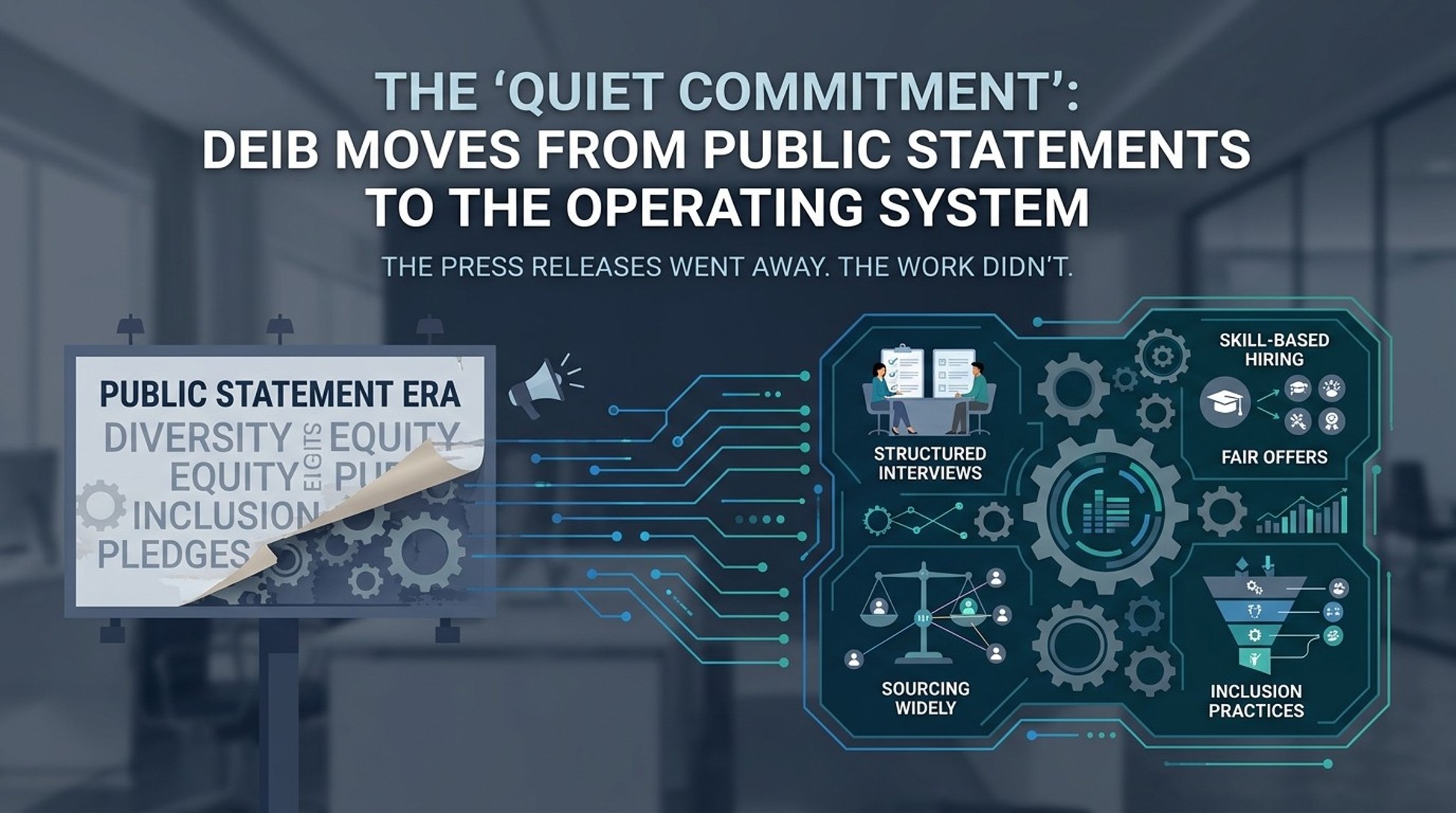
That’s the whole story of DEIB (Diversity, Equity, Inclusion, Belonging) in 2026. The press releases went away but the work didn’t. It went quiet, and it moved into the operating system of the business. And recruiting is where most of that operating system lives.
The Great Disappearing Act
The retreat from public language is real and it’s measurable. The Conference Board found use of the “DEI” acronym in S&P 500 annual filings fell 68% in a single year, and more than half of S&P 100 companies changed how they described the work. The share of S&P 500 companies disclosing DEI metrics in executive pay was cut nearly in half. The Human Rights Campaign’s Corporate Equality Index saw Fortune 500 participation drop from 377 companies to 131.
Now look underneath the headlines. In that same Conference Board data, the share of S&P 500 companies disclosing board-level oversight of this work went up, from 72% to 79%. A 2026 Catalyst and NYU Meltzer Center survey of more than 2,000 employees and leaders found 80% say their organizations remain committed to inclusion. Fifty-five percent of organizations publicly signaled a retreat, but only 34% actually cut back. Among companies that aren’t federal contractors, 52% expanded their inclusion practices over the past three years, versus 20% that reduced them. The bottom line is we’re seeing less talking, fewer slogans, and more governance and systems.
The public statement was always the cheapest part of the program. The expensive part was never the press release. It was the process.
The Statement Era Was Always the Easy Part
The wave of pledges earlier this decade were mostly sincere. Very few of them changed who got an interview.
A statement on the careers page doesn’t decide anything. What decides who gets hired is a long chain of unglamorous choices: how the req was written, where the recruiter sourced, which questions each interviewer asked, how the debrief weighed the feedback, and how the offer was set. Every one of those is a process decision. And every one of them can quietly tilt the outcome in either direction, whether or not anybody ever issued a statement about it.
That’s why the “quiet commitment” isn’t a retreat for serious practitioners. It’s a return to where the leverage always was. If the bias lives in the process, so does the fix.
Would you judge your sales team’s performance by its mission statement? Then why were we ever judging inclusion that way?
Good News
Here’s the argument that should settle a lot of boardroom debates: the most inclusive hiring practices are also the most predictive ones.
When Paul Sackett and colleagues re-ran decades of personnel-selection research in 2022, structured interviews came out as the strongest single predictor of job performance. Meanwhile, the things we lean on out of habit, unstructured “let’s just chat” interviews, years of experience, and educational credentials, sit near the bottom of the validity rankings.
That’s right – the practice that gives every candidate the same questions, scored against the same rubric, is both the fairest method you have and the one most likely to identify your best hire. You don’t have to choose between merit and inclusion. Done right, they’re the same.
The most inclusive hiring practice in your toolkit is also the most predictive one. That’s not a coincidence.
Where the Quiet Work Actually Lives
If DEIB is becoming an operating system instead of a campaign, here’s what that looks like inside a recruiting function. Every move is a shift in the question you ask.
- Instead of publishing a pledge, ask: does every candidate for this role get the same core questions, scored on the same rubric, by interviewers who’ve actually been trained on it?
- Instead of screening for “culture fit,” ask: which specific behaviors does this role require, and how would we see them in an interview?
- Instead of defaulting to a degree requirement, ask: which outcome does this credential actually prove, and is there another way to show it? (I made the full case for this in a recent article, The Degree Dilemma: Why Major US Firms Are Dropping Degree Requirements).
- Instead of letting negotiation skill set the offer, ask: is there a documented band, and a written rationale for where this offer lands in it?
- Instead of sourcing from the same five schools and the same two competitors, ask: where else does this skill actually live?
- Instead of waiting for someone to request an accommodation, ask: does every interview invite tell candidates, plainly, how to get what they need to do their best?
- Instead of an annual diversity report, ask: does our ATS show us, stage by stage, where candidates fall out of the funnel, and can we spot any pattern in a timely manner?
None of these needs a press release. All of them change outcomes. And almost all of them are things you already should be doing for quality-of-hire reasons alone.
Campus Recruiting Has It Figured Out
I refer to campus recruiting programs often when writing about this topic. Anyone who’s run a large campus program knows why. When you’re pushing hundreds of first-round interviews through dozens of interviewers in a short time window, you can’t let everyone “go with their gut.” You’d get forty interviewers grading forty different ways. So early talent teams built standardized questions, shared scoring guides, and calibration sessions, not because anyone labeled it an inclusion initiative, but because it was the only way to make fair, consistent decisions at volume.
Early talent also learned that an overly narrow “core school” list starves the pipeline. The programs that widened their reach and screened on demonstrated skills instead of school prestige found more talent, not less.
Nobody wrote a statement about any of that. They just built the process. That’s the quiet commitment in its purest form, and it’s existed in your campus program for years.
Does Quiet Just Mean Hiding?
Candidates notice silence. The same Catalyst and Meltzer research found 74% of respondents are more likely to apply to organizations that reaffirm their inclusion commitments. When a company scrubs its language overnight, plenty of candidates read that as a retreat, whether it is one or not. And as I wrote a few weeks ago (Employer Brand: Why “Culture Videos” Are Out and “Employee Evidence” Is In) , candidates now trust what your employees say far more than anything your brand publishes.
But quiet doesn’t have to mean silent. There’s a big difference between a pledge and a process description. “Every candidate for this role gets the same structured interview and is scored on the same criteria” is a promise any company can make, it’s legally unremarkable, and, most importantly, it’s verifiable. Candidates can experience it. Your employees can confirm it. That’s worth more than any statement you took down.
The second objection is usually legal: “Our counsel told us to leave this alone.” Talk to counsel, absolutely, especially if you’re a federal contractor, where the obligations and scrutiny are genuinely different. But notice what’s on the list above. Consistent questions, consistent scoring, documented pay rationale, broader sourcing, accessible processes, funnel monitoring. These are systems that hold every candidate to the same standard. That’s not the risky part of your hiring process. The risky part is the unstructured interview where nobody can explain why one candidate advanced and another didn’t.
The Real Question
The era of the corporate diversity statement is fading, and honestly, a lot of practitioners won’t miss it. Statements were easy to write and hard to measure. Systems are hard to build and easy to measure. That’s exactly why they last.
So here’s a test worth running with your leadership team: if your company deleted every public DEIB statement tomorrow, what would still be running next week? Would your interviews still be structured? Your offers still banded? Your funnel still monitored? If the honest answer is “not much,” the commitment was never in the operating system to begin with.
What has your organization kept running quietly, even as the public language changed? I love comments and would genuinely like to compare notes to what I’m seeing.
If you want to build hiring processes that are fair by design, defensible by default, and don’t depend on anyone’s press release, that’s exactly the kind of work ES Talent Solutions does. Reach me directly at estewart@ESTalentSolutions.com and let’s talk.
#DEIB #InclusiveHiring #TalentAcquisition #StructuredInterviews #RecruitingStrategy #HRLeadership #ESTalentSolutions



0 Comments
Ageism in the AI Era: Is Your Process Screening Out Your Most Loyal Hires?
Your AI screener doesn’t need to know a candidate’s age. A graduation year and a 25-year work history give it away. Workers over 50 stay roughly three times longer, and the Workday lawsuit shows what screening them out can cost.
Remote Work Isolation: Not a Culture Problem but a Recruiting One
Remote work isolation isn’t a real estate problem. Lonely workers are nearly twice as likely to job hunt, and office workers are just as lonely. The fix starts in your interview loop, not your office lease.
Employer Brand: “Culture Videos” Are Out and “Employee Evidence” Is In
Your $40K culture video got 11 seconds of watch time. An engineer’s grainy video of her Tuesday got more comments than your careers page did all quarter. Candidates trust employees three times more than your brand, and here’s how to build on that.