
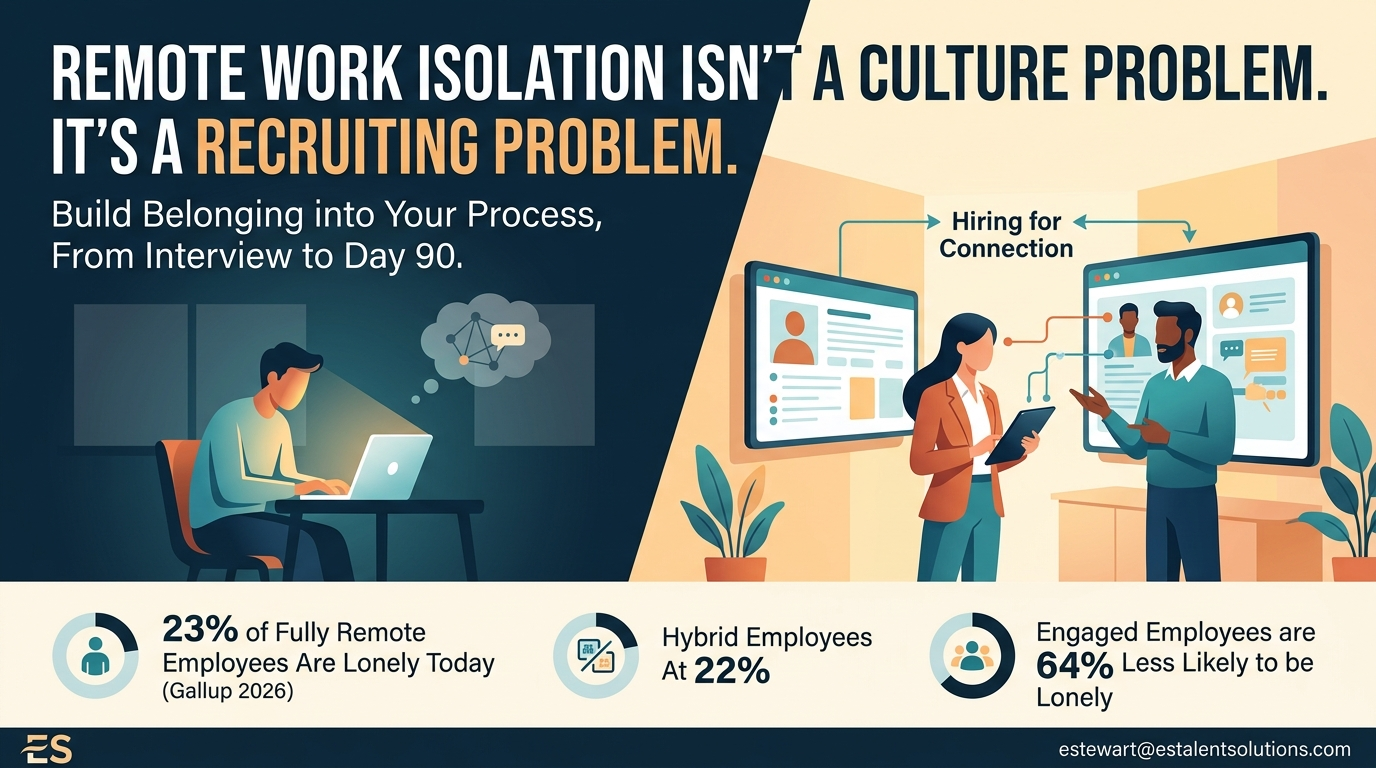
Twenty-three percent of your fully remote employees are lonely today. Not overworked, not disengaged, not “having a rough quarter”. They’re lonely, in the specific, measurable sense Gallup actually tracks. What’s surprising is your hybrid employees clock in at 22%. Some think “isolation is the tax we pay for letting people work from home, and the fix is getting them back in a building”. The numbers above state otherwise.
The problem is most companies are still recruiting, screening, and onboarding as though belonging is something that shows up on its own, over a shared coffee machine or a mandatory Friday Zoom happy hour. On a fully distributed team, it doesn’t show up on its own. It gets built, deliberately or it doesn’t get built at all. And right now, almost nobody is hiring for it.
For years, “culture fit” in an interview meant something loose and mostly about vibes: would this person get along with the team and fit the unspoken norms of the office. On a fully distributed team, it’s close to useless, because the thing that actually determines whether someone belongs isn’t whether they’d be fun at the holiday party. It’s whether they know how to build a real working relationship with a teammate they will never physically meet, using nothing but Slack threads and the fifteen minutes of calendar overlap you both have.
That’s a skill. It’s teachable, it’s assessable, and almost nobody is assessing for it. Instead, TA teams screen for technical ability, run a values-alignment conversation that’s really just a personality check, extend the offer, and quietly hope the new hire figures out how to feel like part of the team on their own. Would you hire a salesperson without ever checking whether they can build rapport with a stranger? That’s essentially what’s happening every time a remote team skips this and hopes belonging sorts itself out.
The Isolation Math
The mechanism behind this is more structural than most leaders assume. Research published in Science in mid-2026 found that people in remote-capable jobs spend 58% more hours alone than their on-site counterparts, have 72% higher odds of going an entire day with zero human contact, and for people living alone, that jumps to 83% higher odds. That’s not a vibe. That’s a measurable change in how many real conversations a person has in their day, and it happens whether or not your engagement survey ever asks about it.
Gallup’s most recent global data shows loneliness isn’t evenly distributed by age either: 27% of Gen Z remote-capable employees report frequent loneliness, compared to 21% of Millennials, 15% of Gen X, and just 10% of Baby Boomers. Your newest, least-tenured hires, exactly the people you’re asking to build relationships from scratch with no institutional history to lean on, are carrying the heaviest isolation load. And the business cost isn’t abstract: Cigna’s data shows 36% of lonely workers are likely to look for a new job, versus 20% of workers who aren’t lonely, and lonely employees miss 35% more workdays than their connected peers.
36% of lonely workers are likely to look for a new job versus 20% of workers who are not lonelyHere’s the one number that should reframe how you think about fixing it: Gallup finds engaged employees are 64% less likely to be lonely. Loneliness isn’t purely a function of physical distance. It’s downstream of whether someone feels like their work and their team actually need them. That’s a design problem you can hire and onboard for. It is not a real estate problem you can solve with a badge swipe.
Where It Gets Complicated
Now, before you forward this to your CEO as ammunition for a permanent remote policy, or your facilities team as ammunition for the opposite, the data has a wrinkle that matters more than either headline. Gallup’s 2026 numbers show the loneliness gap between exclusively remote workers, hybrid workers, and on-site remote-capable workers has nearly closed: 23%, 22%, and 22% respectively. Being in a building is no longer a meaningful protection against feeling isolated at work. If anything, on-site remote-capable employees (people who could work remotely but are required not to) are the least engaged group Gallup measures anywhere, at just 17% engagement versus 25% for fully remote workers.
So the popular fix, mandate people back to a physical location and belonging will sort itself out, isn’t just unpopular. It doesn’t work, and forcing it tends to backfire in exactly the way you’d expect: separate 2026 survey data found 61% of remote and hybrid workers would seriously consider leaving if hit with a return-to-office mandate, with women (65%) and Millennials (64%) most likely to walk. You’d be trading a belonging problem you could actually design your way out of for a retention crisis you can’t take back once the resignations start.
The uncomfortable takeaway: physical proximity was never the mechanism. Connection was. Companies that happened to be in-person got some of it for free, through hallway conversations nobody had to schedule. Distributed companies don’t get that for free. They have to build it on purpose, which sounds like more work, right up until you realize “on purpose” is a process you can actually control, instead of hoping the office layout does your culture work for you.
What Not to Do
The instinct in a lot of leadership meetings is to treat this as a programming problem: add a mandatory virtual happy hour, stand up a Slack channel for “watercooler chat,” maybe throw in a quarterly meeting with a trivia game bolted on. You know the one, six people unmute at once to say “no, you go ahead,” somebody’s dog starts barking, and everyone logs off feeling slightly more alone than when they started. None of that touches the actual mechanism, because it’s applied after the hire is already isolated instead of being built into how you sourced, interviewed, and onboarded them in the first place.
The second instinct, just as common, is to assume this is purely a management problem and has nothing to do with recruiting. That’s how you end up with a values-based interview loop that spends forty-five minutes assessing whether someone seems “collaborative” without ever testing whether they know how to actually build a relationship asynchronously, and then a new-hire experience where 20% of employees say their company made zero structured effort to help them find peer support. You hired for the job. You didn’t hire, or onboard, for the belonging the job actually requires.
How to Recruit for Belonging
The key is to build this into the process instead of hoping it happens after the offer letter.
First, put a real behavioral question about asynchronous relationship-building into every distributed-role interview session. Not “how do you handle working remotely,” which invites a rehearsed answer about discipline and a home office setup. Ask a backend engineer how they’ve built trust with a teammate they’ve never met synchronously, someone whose code review comments they read at 11pm their time and respond to the next morning. Ask a customer support hire, who’ll be the only person on their shift in their time zone, to describe the last time they proactively reached out to a colleague they didn’t need anything from. The answer tells you whether this person initiates connection or waits for it to be handed to them. On a distributed team, waiting is a liability.
Second, build a “first contact map” before the offer is even signed, not during week one when everyone’s too busy to think about it. Decide, specifically, which three to five people this new hire needs a real relationship with in their first month, and get those conversations on the calendar before day one. This isn’t a nice-to-have. Structured buddy programs are linked to a 52% lift in retention and a 60% faster ramp to productivity. That’s not a soft metric. That’s a number your CFO will actually care about.
Third, make the hiring manager’s onboarding role explicit and measured, not a vague expectation that they’ll “check in.” Gallup found new hires whose managers were actively, visibly involved in onboarding were 3.4 times more likely to describe the experience as exceptional. On a remote team, “actively involved” has to mean something concrete: a scheduled 1:1 in week one that isn’t about tasks, an intro thread the manager personally writes instead of delegating to HR, a standing quick sync-up in the first month that exists purely to ask how the person is actually doing.
Fourth, treat time zone overlap as a real role-design and hiring criterion, not an afterthought you solve after the offer’s accepted. If a role genuinely has only ninety overlapping minutes a day with the rest of its team, that’s not just a scheduling inconvenience, it’s a structural cap on how much real connection that person can build, no matter how personable they are. Sometimes the fix is adjusting the hiring profile toward candidates in closer time zones. Sometimes it’s building deliberate overlap time into the role itself. Either way, that’s a decision to make at the req-writing stage, not something to discover three months in when the new hire quietly starts job searching.
Fifth, track a connection signal in your 90-day check-ins with the same seriousness you track ramp-up metrics. Eighty-six percent of new hires decide whether they’re staying long-term within their first six months, and a third of new hires report their onboarding lacked real human interaction, a number that jumps to 41% for Gen Z specifically. If you’re measuring time-to-productivity but not asking “who have you built a real working relationship with so far,” you’re missing the metric that’s actually predicting whether this hire is still here at month nine.
The Real Question
Remote work isolation was never really about where someone’s desk is. It’s about whether anyone designed the relationships a new hire needs, on purpose, instead of assuming they’d form the way they used to, by accident, in a hallway that doesn’t exist anymore. You can keep treating belonging as a problem to solve with better swag and more optional Zoom socials, or you can start treating it as what it actually is: a recruiting and onboarding design question, with an interview loop that screens for it and a first ninety days built around it.
When’s the last time your hiring process actually asked a candidate how they build relationships with people they’ll never see in person? If the honest answer is never, that’s worth fixing before your next distributed hire, not after they’ve quietly started looking. Drop a comment, I’d genuinely like to hear how other TA teams are building this into their loops.
If your distributed team is bleeding people to quiet isolation and you’re ready to build hiring and onboarding processes that actually address it instead of another optional happy hour, that’s exactly the kind of work ES Talent Solutions does. Reach out (estewart@estalentsolutions.com ) and let’s talk.
#RemoteWork #Belonging #TalentAcquisition #EmployeeExperience #DistributedTeams #HRLeadership #ESTalentSolutions



0 Comments
Ageism in the AI Era: Is Your Process Screening Out Your Most Loyal Hires?
Your AI screener doesn’t need to know a candidate’s age. A graduation year and a 25-year work history give it away. Workers over 50 stay roughly three times longer, and the Workday lawsuit shows what screening them out can cost.
Quiet Commitment: Why DEIB Is Moving From Public Statements to the Invisible
“DEI” mentions in S&P 500 filings fell 68% in a year. But most companies didn’t cut the work. They moved it into the hiring process, and the fairest practices turn out to be the most predictive too.
Employer Brand: “Culture Videos” Are Out and “Employee Evidence” Is In
Your $40K culture video got 11 seconds of watch time. An engineer’s grainy video of her Tuesday got more comments than your careers page did all quarter. Candidates trust employees three times more than your brand, and here’s how to build on that.