
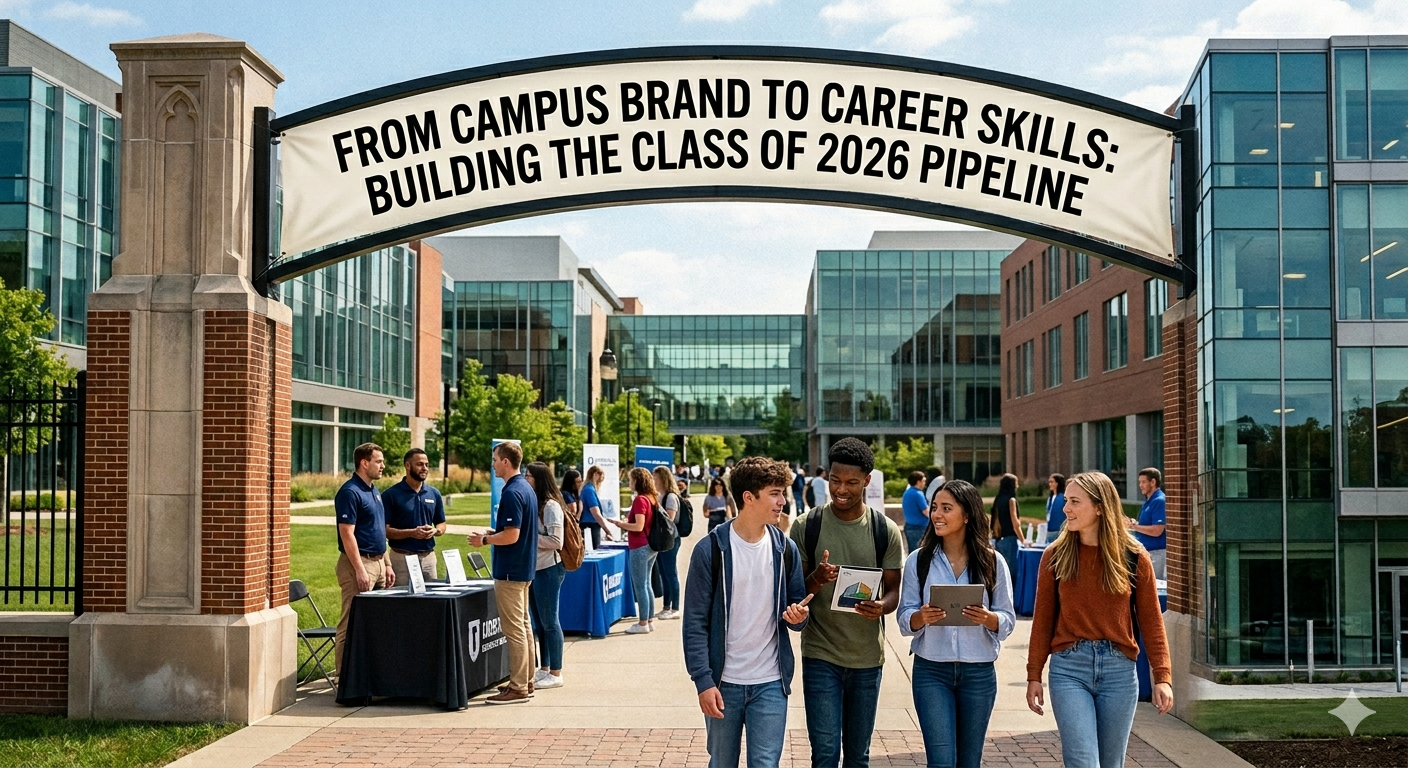
In the spirit of celebrating my son’s recent graduation and continuing the “Skills First” theme of the last few weeks, let’s go to campus!
The Scene at Every Career Fair (Circa Forever)
The banner is up. The matching polo shirts are looking good. QR codes that link to the careers page are displayed prominently. Your brand manager sent over a box of stickers and a rep from the business unit is flying in to talk about “culture.”
200 resumes collected, 40 students interviewed, 12 offers extended with 8 accepting. Next year, you do it all over again.
There’s nothing necessarily wrong with this. It is filling the roles. But this campus recruiting model was designed for a different labor market, a different generation, and a different definition of “qualified.”
The Class of 2026 is about to enter the workforce. And if your early talent strategy is still organized around campus brand presence, you’re optimizing for the wrong thing entirely.
The Problem Isn’t Awareness. It’s the Filter.
I spent years running the campus recruiting program at a large company and I saw that most campus recruiting programs are built to generate volume, not best possible match. You’re measuring booth traffic, resume submissions, and event attendance, not skill alignment, role readiness, or likelihood to stay past 18 months.
“Brand” became a proxy for quality because it was measurable and marketable internally. But brand doesn’t predict performance. It predicts name recognition. Those are very different things.
A 2024 National Association of Colleges and Employers (NACE) study found that fewer than 45% of employers felt their campus hires were “fully prepared” for the role within the first six months. That’s not a Gen Z problem. That’s a selection problem.
The students who can do the work don’t always look the part. They didn’t go to your target schools. They didn’t join the right clubs. They didn’t know to show up at your booth. And your current model is filtering them out before they ever get a conversation.
What “Skills-Based” Actually Means for Early Talent
Skills-based early talent recruiting isn’t about replacing degrees with certifications (though that’s part of it). It’s about redesigning the entire pipeline so that the signal you’re collecting at every stage is capability, not credential.
That means asking different questions at each stage:
Instead of: “Did they go to a target school?” Ask: “Have they demonstrated the specific thinking, collaboration, or technical skills this role requires?”
Instead of: “Did they pass a 30-minute behavioral screen?” Ask: “Have we given them a structured opportunity to show us how they work?”
Instead of: “Do they have a 3.5+ GPA?” Ask: “What is their GPA actually a proxy for, and is that proxy relevant to this role?”
None of this is soft. It’s actually harder to execute than the traditional model, which is exactly why most TA teams haven’t done it yet.
Four Structural Shifts to Build a Skills-Based Pipeline
1. Detach Sourcing from Campus Geography
Your “target school list” is a legacy artifact. It was built for a world where proximity to campus drove relationship depth, and where pedigree was a shortcut most hiring managers accepted without question. Neither of those things is as true as it used to be.
Virtual recruiting, asynchronous video, and campus-agnostic platforms (Handshake’s national reach, LinkedIn’s student filter, project-based communities like GitHub or Behance) have broken the geographic logic. You can now source a mechanical engineering student from a state school with a stellar project portfolio just as easily as you can source one from your flagship partner institution.
Consider expanding your sourcing footprint to twice as many schools, dramatically reduce on-campus event investment per school, and reallocate that spend toward virtual skills-based engagement.
2. Build the Assessment Into the Experience, Not After It
Here’s where most programs miss. They do the fun, brand-forward stuff first (case competitions, campus coffee chat, the “meet our people” event) then tack on the assessment.
By that point, students are in the funnel based on enthusiasm and self-selection, not demonstrated skill. And your hiring team is pattern-matching on “culture fit” rather than capability. Flip this. Make the skills demonstration the entry point.
Real-world example: A firm I work with redesigned their analyst pipeline so that the first step after application is a 45-minute simulated analysis exercise (for more about simulations, read Behavioral Assessments 2.0: Moving Beyond the “Tell Me About a Time” Question to Real-World Simulations) not a phone screen, not a video interview. Just: here’s a dataset, here’s a business question, here’s what we want you to do with it. The right people moved forward, quality of conversation in subsequent rounds increased, and time to decision was cut in half. You lose the students who weren’t that serious. You keep the ones who can actually do the job.
3. Redefine What “Diversity of Pipeline” Means
Skills-based recruiting is the most underused tool in early talent DEI strategy, and almost nobody is talking about it this way.
When you remove target school lists, GPA cutoffs, and traditional credential gates as primary filters, you naturally surface talent that your previous model was excluding. First-generation college students. Community college transfers. Students who worked 30 hours a week and graduated with a 3.1 instead of a 3.7.
The caveat, and it matters, is that if your assessment design is biased, you’ve just moved the inequity downstream instead of removing it. Work samples and structured simulations can still advantage students who’ve had more exposure or preparation. Your assessments need to be tested, normed, and reviewed through an equity lens. That’s not optional. But the directional move is right: measure capability, and you’ll find more of it in more places.
4. Create Cohort-Level Feedback Loops Between Campus and Performance
This is the long game, and most teams skip it because it’s unglamorous but, if you don’t know how your Class of 2024 hires are performing right now, you cannot make good decisions about your Class of 2026 recruiting strategy.
Skills-based pipelines get better over time only if you’re closing the loop. Which early signals actually predicted six-month performance? Which assessments correlated with retention? Which source channels produced the hires who got promoted?
Build a simple tracking structure. Match your hiring cohort data to your performance data at 6 and 12 months. Bring that analysis into your campus strategy planning meeting. If your TA team doesn’t have access to that downstream data, that’s the first problem you need to fix.
What About the Class of 2026 Specifically?
Fair question. Why now? Why this class? A few things are converging:
The AI literacy gap is real and it’s already a differentiator. Students who have been using AI tools actively, not just passively, to do their coursework, projects, and internship work are entering with a capability advantage that doesn’t show up on a transcript. Your traditional screening process will miss this entirely.
Post-pandemic cohorts have a different relationship with work norms. This isn’t a culture lecture — it’s a practical observation. Students entering in 2026 have spent their formative college years navigating remote, hybrid, self-directed work. They’re often better at asynchronous collaboration and worse at unstructured in-person environments than classes two years ahead of them. Your onboarding model matters more than it did in 2019.
The market is tighter than headlines suggest. Entry-level hiring volumes dropped sharply in 2023-2024, and many companies paused campus programs entirely. The students who are entering now are sophisticated about what’s happening. They know the market is competitive, they’ve watched older peers struggle, and they’re more discerning about where they apply. Weak employer branding still hurts you. It just hurts you later in the funnel.
The One Thing That Doesn’t Change
None of this means relationships don’t matter. Faculty partnerships, alumni ambassadors, targeted presence at specific programs, etc. still move the needle. The students who choose your offer over a competitive one still do it partly because of how your people showed up. The shift isn’t from brand to no-brand. It’s from brand as a filter to brand as the closer. Let the skills-based work sort the pipeline. Let the human connection seal it.
What’s Your Current Model Actually Measuring?
If you ran a skills audit of your campus recruiting process today (meaning, you mapped every touchpoint and asked “what signal about actual capability does this generate?”), how would it hold up?
That’s the question worth sitting with before your fall recruiting calendar gets locked.
At ES Talent Solutions, we work with TA teams to redesign early talent programs that actually connect to performance outcomes — from assessment architecture to sourcing strategy to cohort analytics. If your campus program is due for a rethink, let’s talk.
What’s the biggest structural barrier you’re hitting in moving to skills-based early talent pipelines? Drop it in the comments — I read everything.


0 Comments
The Regulatory Roadmap, Part 2
January 1 brings new AI hiring rules in Colorado and California, and they all start with one question: which tools in your funnel score, rank, or filter candidates? Most compliance problems in 2027 will start as inventory problems in 2026.
The Regulatory Roadmap, Part 1: Auditing your Automated Sourcing & Screening Tools
January 1 brings new AI hiring rules in Colorado and California, and they all start with one question: which tools in your funnel score, rank, or filter candidates? Most compliance problems in 2027 will start as inventory problems in 2026.
Ageism in the AI Era: Is Your Process Screening Out Your Most Loyal Hires?
Your AI screener doesn’t need to know a candidate’s age. A graduation year and a 25-year work history give it away. Workers over 50 stay roughly three times longer, and the Workday lawsuit shows what screening them out can cost.