
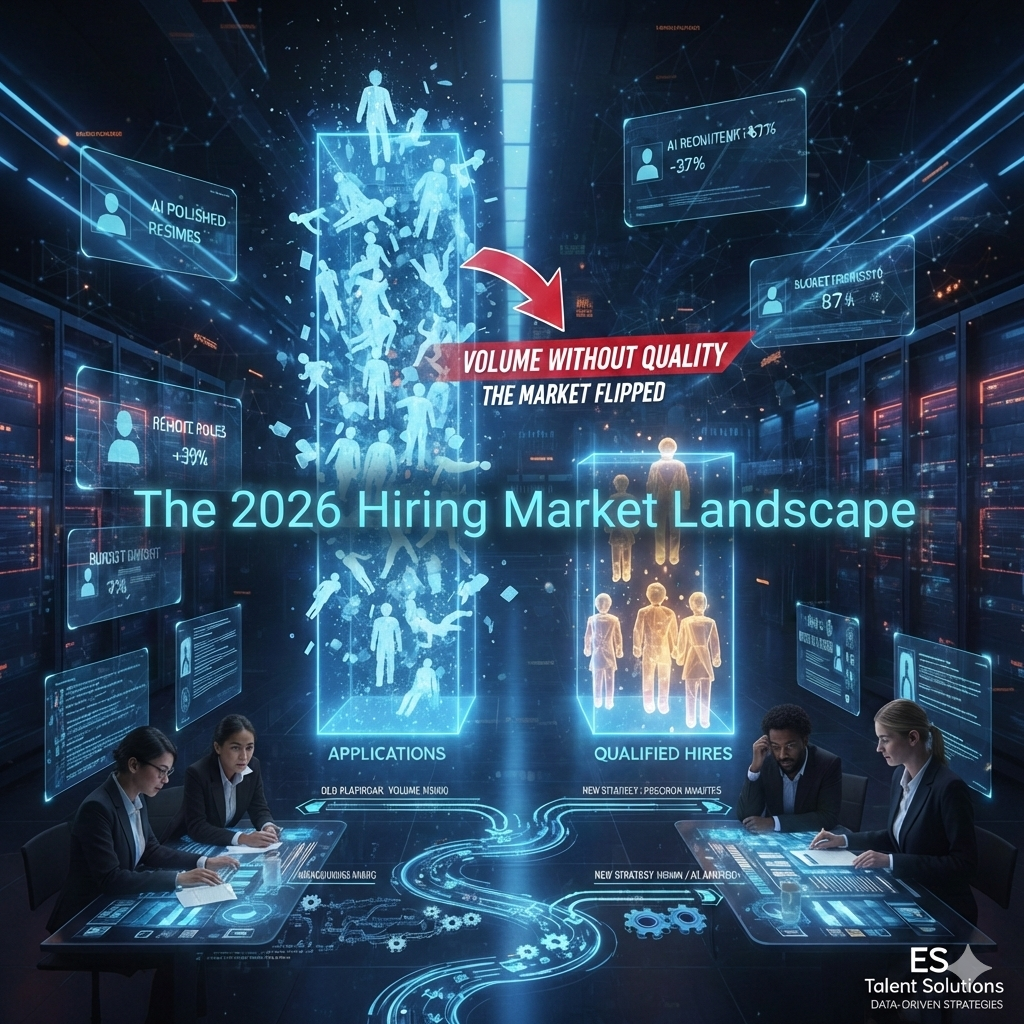
Last week, I shared my ideas on where the market was moving for job seekers in 2026. In summary, it’s not going to get better or worse – it’s changing ( see “The 2026 Job Market: What the Data Actually Tells Us“). This week, we focus on what companies are facing for the hiring market in 2026.
Here’s the dilemma recruiters face in 2026: 69% of recruiters struggle to find qualified candidates, even as application volumes surge. Indeed reports that job openings are poised to stabilize but may not grow much, while unemployment rises. You’re drowning in applications but starving for talent.
Why? It’s been regularly reported that generative AI tools allow candidates to polish resumes, craft compelling cover letters, and even generate interview responses in real-time. For recruiters the “noise” has never been worse because, even as a recruiter identifies resumes of interest, they may not be identifying genuine talent to fill their openings. Recruiters are dealing with an new era of “Volume without quality”.
The Entry-Level Crisis Isn’t Just About Candidates
Organizations will face unprecedented volumes of applicants competing for significantly fewer placements in 2026. The traditional early career model, mass hiring of recent graduates into generalist and training-intensive roles, is being dismantled by AI.
To navigate this new world, organizations must fundamentally rethink their early-career strategy, shifting from volume hiring to precision hiring for specialized roles. And here’s the issue in 2026 – Most recruiting teams aren’t set up for this. They’re still using playbooks built for a candidate-driven market, not an employer-driven one.
Budget Pressure Is Real
These numbers paint a grim picture. Only 16% of U.S. organizations anticipate a salary budget higher than 2025. The same proportion expects budgets to be lower, while 68% believe they’ll hold steady. Among those with lower budgets, 66% cite economic worries as the primary reason.
This creates a squeeze on recruiting departments. You need specialized talent, which commands premium compensation, but have flat or declining budgets. The talent you can afford isn’t the talent you need. The talent you need is being pursued by every competitor with similar constraints.
The Skills Gap Is Quantified and It’s Bad
The World Economic Forum’s Future of Jobs Report states that 39% of workers’ skills will be transformed or outdated in the next five years. More than 21% of IT recruiters expect to face challenges hiring AI and machine learning specialists. The average time to fill a tech position is approximately 52 days.
45% of employers say they struggle to find qualified candidates. This isn’t about being picky. It’s about fundamental mismatches between what organizations need and what’s available in the labor market. I haven’t seen any viable plans from companies to retool or upskill their workerforce to reduce the gap (and I’ve looked).
Remote Work Is Still A Competitive Edge
One thing the data is clear about – 52% of talent acquisition leaders say office mandates hinder recruitment, while 72% find remote roles easier to fill. Remote job postings have increased 357% since the pandemic, and data shows 70% of the workforce will be remote at least five days a month (i.e. work remotely one day a week) by the end of 2026.
When asked how likely millennials would be to look for another job if remote options were unavailable, 41% said “extremely likely.” If your best candidates are going where the flexibility is, and you’re requiring office presence for roles that could be done remotely, you’re voluntarily handicapping yourself. Yet, my observations throughout 2025 showed a slight trend backwards, with more and more companies announcing back-to-office mandates.
AI Is Reshaping Recruiter Roles Faster Than Expected
By 2026, AI agents will be capable of managing entire workflow segments without human intervention, potentially handling up to 80% of transactional recruitment activities including initial resume screening, chatbot-driven Q&A, interview scheduling, and due diligence documentation. This will be the year that companies who have hesitated to get involved with AI recruiting tools take the jump.
Some reports show as much as 87% of companies are using AI-powered recruiting software. If the number is really that high, it’s because they are using simple AI administrative tools. As mentioned above, the big shift in 2026 will be broader use of assessment, scheduling, and onboarding tools which “own” larger chunks of the recruiter process (Note – among other things, this is due to a shift from generative AI to agentic AI). The good news is 67% of HR leaders believe in investing in HR analytics to streamline hiring (this hasn’t always been the case in the past). The recruiters who survive these changes won’t be the ones who resist this shift. They’ll be the ones who evolve into specialists focused on building authentic relationships, conducting nuanced assessments, persuading passive candidates, and ensuring ethical AI deployment.
The Segmented Talent Model Is Taking Over
Organizations are increasingly adopting “segmented” talent strategies that allow them to scale capabilities based on actual need. Talent sprints (initiatives based on weeks or months, not years), selective outsourcing, and RPO partnerships are growing because the traditional model of building permanent, full-scale recruitment infrastructure doesn’t match market volatility.
Kelly Services and ManpowerGroup, among others, have seen major rises in demand for their RPO services. Clients don’t want one-off vendors who can fill roles. They want strategic partners who can solve hiring problems. This fundamentally changes what recruiting success looks like.
What Recruiters Need to Do
Stop measuring yourself by time-to-fill and start measuring by quality of hire. Build precision targeting for specialized roles rather than broad pipelines. Invest in AI tools that handle transactional work so you can focus on relationship building and assessment (I wrote about this a few weeks ago – see “The Future of Recruitment“). And if you’re still requiring office presence for roles that could be remote, get comfortable explaining why you’re willing to lose top candidates over it.
The data also suggests that organizations focusing on upskilling current employees are building more sustainable talent pipelines than those relying solely on external hiring. 90% of business leaders say employee engagement and retention are top challenges. Internal development isn’t just retention strategy – it’s talent acquisition strategy. And trust me, you’re much better off reskilling trusted employees than trying to compete for unproven talent that all your competitors are also pursuing.
The Bottom Line
2026 won’t be a year of dramatic improvement or catastrophic collapse. GDP growth is expected around 1.8%, unemployment will tick up but remain below 5%, and job creation will continue at a similar pace to 2025. The Economic Policy Uncertainty Index has been at record levels, and there’s little indication that it changes dramatically in 2026.
What changes is the structure of opportunity. Specialized skills beat generalist credentials. Flexibility beats office mandates. Precision beats volume. Organizations and job seekers who understand that the rules have fundamentally shifted, not just been temporarily disrupted but permanently restructured, will navigate 2026 successfully.
Those still operating with 2019 assumptions about how hiring works? The data suggests they’re in for a difficult year.
ES Talent Solutions helps organizations build recruiting strategies based on data, not hope. Want to discuss what the 2026 market means for your specific hiring challenges? Contact Eddie Stewart at estewart@ESTalentSolutions.com. I’m always happy to talk with fellow leaders about building talent strategies that work in the market we actually have, not the one we wish existed.



0 Comments
The Demographic Cliff
The current soft job market is a deceptive illusion masking a permanent, structural labor shortage. Driven by decades of declining birth rates, an aging workforce, and an impending “enrollment cliff,” the U.S. labor force is set to shrink by nearly 6 million workers between 2025 and 2032. While AI-generated spam application floods give employers a false sense of candidate abundance, critical sectors like healthcare and skilled trades face structural deficits that technology cannot fix. Stewart urges talent leaders to stop waiting out market cycles and instead adopt proactive workforce strategies—including internal mobility, phased retirements, broader campus outreach, and alternative talent pools.
The Regulatory Roadmap, Part 2
January 1 brings new AI hiring rules in Colorado and California, and they all start with one question: which tools in your funnel score, rank, or filter candidates? Most compliance problems in 2027 will start as inventory problems in 2026.
The Regulatory Roadmap, Part 1: Auditing your Automated Sourcing & Screening Tools
January 1 brings new AI hiring rules in Colorado and California, and they all start with one question: which tools in your funnel score, rank, or filter candidates? Most compliance problems in 2027 will start as inventory problems in 2026.