
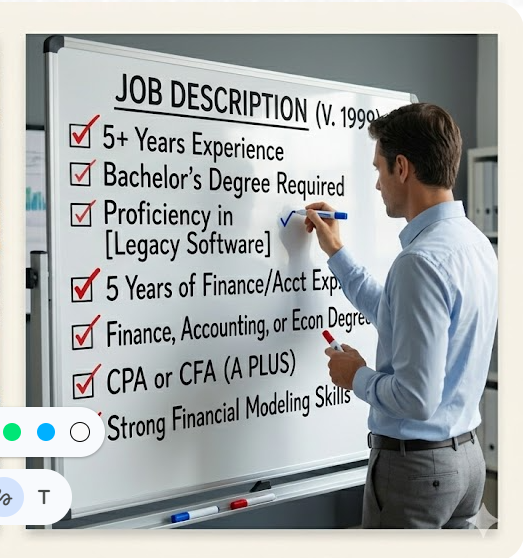
I’m not sure companies understand the difference a well-written job description can make in attracting top talent. It often is the first exposure to prospects yet it’s treated more like a grocery list than an attraction tool. It’s time the traditional job description received a makeover.
My article last week addressed “The degree dilemma” and why adding degree requirements only reduces the candidate pool for those positions where the degree doesn’t directly relate to the work being done (The Degree Dilemma: Why Major US Firms are Dropping Degree Requirements). But there’s much more involved than leaving the degree requirement off the job description. In this two-part series, we’ll break down the structural flaws of traditional job postings and provide a step-by-step guide to writing outcome-oriented job descriptions tailored to a modern talent market.
Every recruiter has been in this situation. The first round of interviews is over and the candidate who looked perfect on paper underwhelms in conversation, while someone who “barely qualified” turns out to be exactly who the team needed. This issue was created well before the first resume is reviewed. It starts with the job description.
Traditional job postings are built around inputs (years of experience, academic credentials, lists of tools, etc.) rather than outputs. They describe the person who has done this job before, not the person who could do it. And in doing so, they quietly filter out high-potential candidates while attracting people who have learned to play the keyword system.
There’s a better approach. It’s called skills-first hiring, and it begins not in the interview room, but in the document that starts the entire process: the job description itself.
The Core Problem with Traditional Job Descriptions
Most job descriptions were written by copying the last job description. Then that one was copied from the one before it. Somewhere back in the chain, someone sat down and thought “What kind of person have we always hired for this role?” And then they made a list.
The result is a set of checklist items, like “5+ years of experience,” “Bachelor’s degree required,” “proficiency in [ insert software tool here]”, that may have little to do with whether someone can actually perform the job today.
Research consistently shows these requirements disadvantage qualified candidates from non-traditional backgrounds, reduce workforce diversity, and don’t reliably predict performance. Yet they persist, largely out of habit. The problem is describing who we want rather than what we need done.
A skills-first job description flips this. Instead of starting with the resume you’d like to see, it starts with the outcomes the role needs to deliver, then works backward to identify what capabilities make those outcomes possible.
Inputs vs. Outputs: The Shift to Outcome-Oriented Job Descriptions
What does this mental shift look like when putting pen to paper? Let’s compare how a traditional posting and a performance-based posting describe the exact same mid-level sales role:
| Traditional Job Description (Input-Based) | Skills-First Job Description (Outcome-Based) |
| • 5–7 years of experience in B2B sales | • Within 90 days: Own a pipeline of 40–60 active accounts and achieve weekly outreach targets. |
| • Bachelor’s degree in Business or related field | • Accurately forecast monthly revenue within a 10% margin using CRM data. |
| • Proficient in Salesforce CRM | • Build trusted relationships with mid-market buyers, turning initial conversations into multi-year contracts. |
| • Strong communication skills | • Collaborate across marketing and product teams to share customer insights that sharpen product positioning. |
Notice the difference. The first version describes a person. The second version describes performance. Any candidate reading the second version knows exactly what they’re being hired to do and can make an honest self-assessment about whether they can deliver it.
It’s not hard to see the skills-first approach provides a level of performance needed for success rather than a checklist of things on a resume. Now the real challenge is how to write outcome-oriented job descriptions effectively. We’ll save that for next week!
This can be such a game-changer for your company. Why? Because very few companies are doing it. They screen out great hires using job descriptions that are outdated and then wonder why it’s so hard to find good candidates. This can be fixed!
Next week we will continue the discussion by actually showing you how to write outcome-oriented job descriptions. I’ll also show you how to update that “experience” line to move away from the “5+ years of experience” phrase.
Modernize Your Talent Acquisition Strategy
Is your company ready to move away from legacy tracking and toward competency-based recruitment? ES Talent Solutions helps organizations audit their hiring infrastructure and build modern talent pipelines.
Contact Eddie Stewart today to discuss how we can upgrade your job descriptions and unlock untapped talent pools.



0 Comments
Writing “Skills-First” Job Descriptions: How to Define Outcomes Instead of Requirements – Part 2
Ready to drop legacy requirements? Use our 4-step framework to write outcome-oriented job descriptions that measure performance, depth, and capability.
The Shift to Skills-Based Hiring: Why Major Companies Are Dropping Degree Requirements
Discover why Google, IBM, and 26 states are dropping degree requirements. Explore the data behind skills-based hiring and how to audit your ATS.
Tech Stack Consolidation: Is an Agentic Applicant Tracking System (ATS) Right for You?
A few years ago, it was worthwhile to seek system solutions for each part of the recruiting process but there is an overload of cost, integrations, and maintenance that makes consolidation the way to go today. This article describes the problem and shares the pros and cons of consolidation