
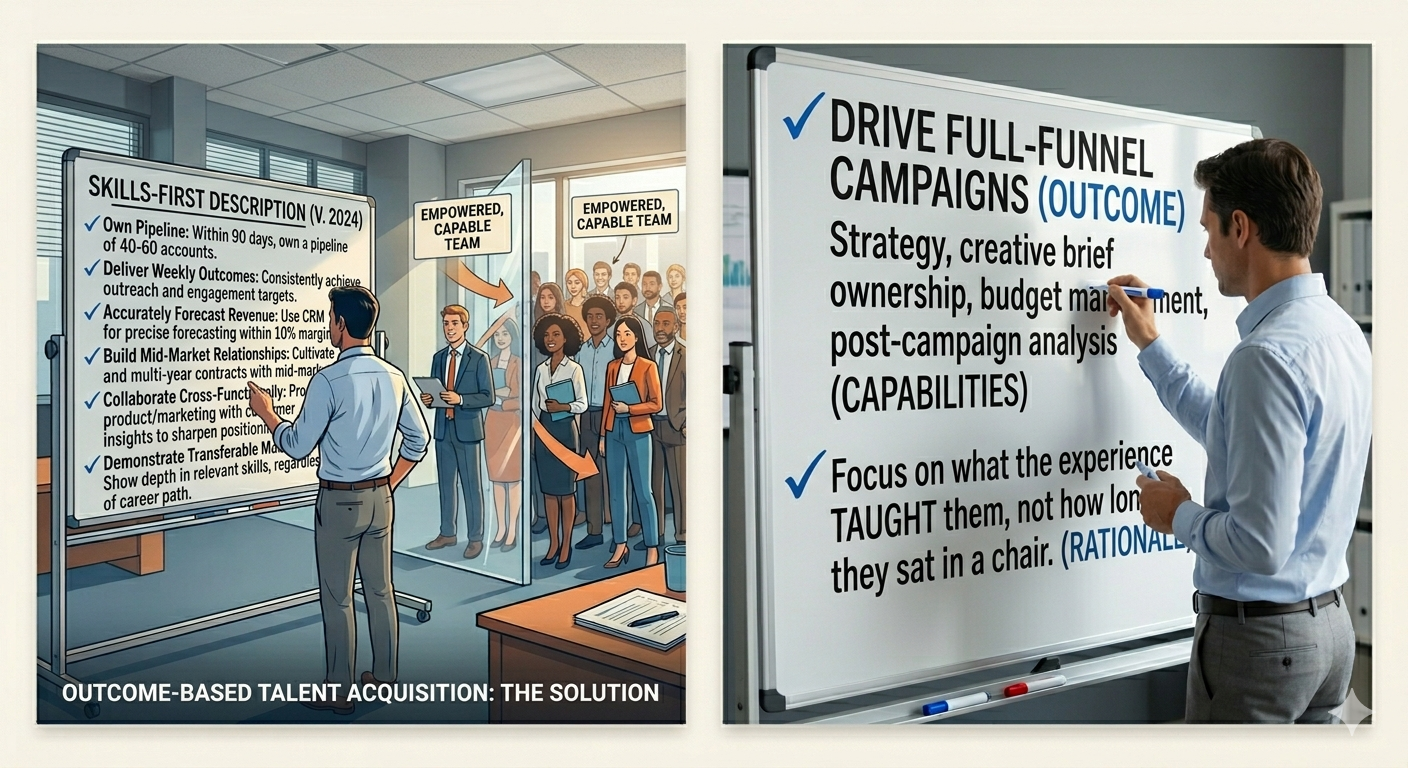
In Part 1 of this series, we explored why legacy, input-based job postings are fundamentally broken. They focus heavily on historical credentials rather than future performance, causing organizations to inadvertently screen out exceptional, diverse talent.
To successfully transition to a competency-based hiring model, your team must learn how to build outcome-oriented job descriptions.
A 4-Step Framework for Writing Outcome-Oriented Job Descriptions
Shifting from a “grocery list” of requirements to a performance-focused layout doesn’t have to be complicated. Use this practical four-step framework to transform your corporate job postings:
Step 1: Start with the 30/60/90 Day Success Plan
Before writing a single bullet point, ask the hiring manager: What does success look like in this role at 30, 60, and 90 days? What milestones should be achieved by month 12? Write those answers down in plain, conversational language. These clear performance milestones form the structural spine of your new job description.
Step 2: Identify Core Capabilities, Not Credentials
For each business outcome you’ve defined in Step 1, identify the exact competencies required to achieve it.
- The Legacy View (Credential): “Must have 3 years of project management experience.”
- The Skills-First View (Capability): “Demonstrated ability to prioritize competing cross-functional demands under tight deadlines.”
Always ask yourself: Is this credential absolute proof of a capability, or are we just requiring it out of corporate habit?
Step 3: Ruthlessly Separate Must-Haves from Nice-to-Haves
Every single requirement you list acts as a barrier to entry. While some gates are legally or technically necessary, most are arbitrary. Go through your draft and ask: If a candidate couldn’t do this specific task but could execute everything else brilliantly, would we still hire them? If the answer is yes, it is a preference, not a requirement. Remove it or label it transparently.
Step 4: Define “Who Thrives Here”
Completely replace the generic “Qualifications” section with a candid, authentic description of your operational environment. Discuss the actual pace of work, the level of ambiguity they will encounter, the team’s collaboration style, and the exact nature of the problems they will solve. This helps candidates self-select—both in and out of the process—ensuring you attract professionals who genuinely fit your culture.
The Solution to the “Years of Experience” Dilemma
This is where most talent acquisition teams get stuck. The common pushback is: “We can’t just remove years of experience from the posting. We’ll get flooded with completely unqualified applicants.”
That is a valid operational concern, but there is an effective middle path. Instead of specifying a chronological number of years, specify the expected depth of experience that actually matters.
- Instead of: “5+ years of marketing experience”
- Try this: “Has successfully led a full-funnel marketing campaign from initial strategy through ROI measurement—including direct ownership of the budget, creative brief, and post-campaign analysis.”
This simple reframe describes what the experience should have taught them, not just how long they sat in an office chair. A highly proactive marketer with three years of deep, hands-on campaign ownership will almost always outperform someone who spent seven years in a strictly siloed support role.
The Hidden Dividend: Better Sourcing and Better Interviews
When you define strategic outcomes clearly in the job description, it creates a powerful downstream effect: your interview loops become significantly more effective.
Instead of asking generic, behavioral interview questions like “Tell me about your experience with CRM data” (which heavily rewards storytelling over substance), your recruiters can ask targeted, skills-based interview questions tied directly to your defined outcomes:
- “Describe a time you had to forecast quarterly revenue with incomplete data. What was your analytical process, and how accurate was the final forecast?”
- “Walk me through the exact methodology you would use to build a pipeline of 50 active enterprise accounts from scratch in a brand-new market.”
- “Tell me about a customer relationship you personally nurtured from a cold outreach into a multi-year enterprise partnership. What specific strategies made that work?”
These questions flow naturally from an outcome-oriented job description, giving candidates the chance to prove their real-world capabilities rather than just reciting their resumes.
The Inclusion and Diversity Advantage
Skills-first job descriptions aren’t just an operational performance optimization; they are a critical milestone toward equitable, inclusive hiring.
Arbitrary degree requirements disproportionately screen out qualified candidates from lower-income backgrounds and underrepresented communities without ever improving the ultimate quality of hire. This is precisely why forward-thinking enterprise employers, from IBM to massive public sector state governments, are stripping degree mandates from thousands of roles.
When you measure outcomes instead of pedigrees, you unlock access to highly capable, untapped talent pools:
- The self-taught developer with an exceptional GitHub portfolio.
- The career-changer with incredible, transferable operational mastery.
- The professional who executed this exact role beautifully at a smaller company but lacks a prestigious corporate title.
This approach isn’t “lowering the bar.” It’s finally measuring what actually matters.
Getting Started: A Step-by-Step Implementation Guide
You don’t need to overhaul your entire enterprise corporate tech stack or recruiting workflow overnight. Pick a single, upcoming open role and try rewriting its job description completely from scratch using the framework above.
To ensure success, use these quick starting points:
- Audit your top performers: Interview the people currently thriving in the role. Ask them what they actually do all day, rather than what their outdated corporate job description says they do.
- Identify hiring manager friction: Ask the hiring manager what frustrates them most about recent hires or past mis-hires. Those pain points almost always point directly to the missing core outcomes that matter most.
- Trim the fat: Remove any requirement that you cannot directly tie back to a 30/60/90 day business outcome. If you can’t justify why it’s there, delete it.
- Beta-test the draft: Share your new draft with a diverse internal group before publishing. Ask them honestly: “Does this description make you want to apply, or does it create unnecessary barriers?”
The job description is your organization’s first impression. It tells the talent market whether you have thought deeply about what you need or whether your talent acquisition function is running on autopilot. High-tier candidates notice the difference instantly.
Modernize Your Talent Acquisition Strategy
Is your company ready to move away from legacy tracking and toward competency-based recruitment? ES Talent Solutions helps organizations audit their hiring infrastructure and build modern talent pipelines.
Contact Eddie Stewart today to discuss how we can upgrade your job descriptions and unlock untapped talent pools.



0 Comments
Ageism in the AI Era: Is Your Process Screening Out Your Most Loyal Hires?
Your AI screener doesn’t need to know a candidate’s age. A graduation year and a 25-year work history give it away. Workers over 50 stay roughly three times longer, and the Workday lawsuit shows what screening them out can cost.
Quiet Commitment: Why DEIB Is Moving From Public Statements to the Invisible
“DEI” mentions in S&P 500 filings fell 68% in a year. But most companies didn’t cut the work. They moved it into the hiring process, and the fairest practices turn out to be the most predictive too.
Remote Work Isolation: Not a Culture Problem but a Recruiting One
Remote work isolation isn’t a real estate problem. Lonely workers are nearly twice as likely to job hunt, and office workers are just as lonely. The fix starts in your interview loop, not your office lease.